Fabrics / Cotton & rayon · Cotton jersey
Cotton Silver-Thread Single Jersey 200 GSM — 156 cm
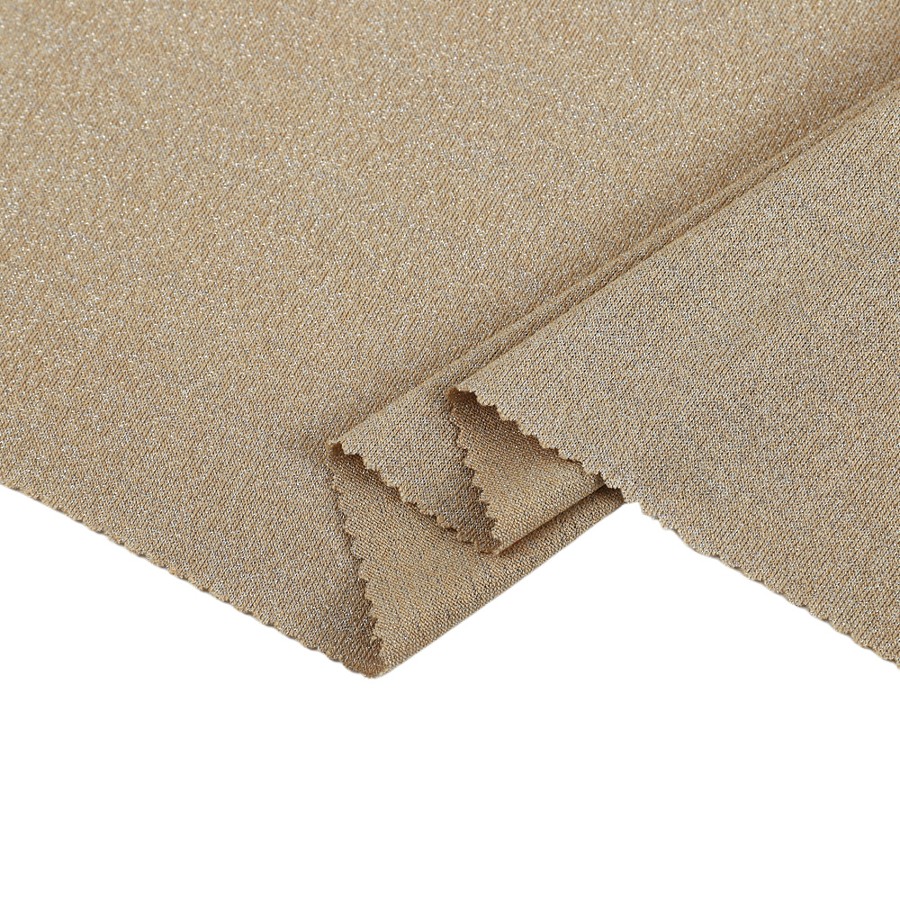
A 200 GSM single jersey in 100% cotton, on a 156 cm width, with a fine metallic-lustre yarn knitted through it. Heavy enough to be opaque and to fall in folds, plain enough to cut as a stable cloth, and touched with a silver fleck that reads as lustre at arm’s length rather than as glitter.
Two things decide whether it suits you. It is a jersey, not a stretch knit — no spandex, so it holds a shape and it does not snap back; anything that has to cling is the wrong brief. And the fleck is in the yarn: it is not a print, not a coating and not a foil, which is why it survives washing but also why it cannot be matched shade-for-shade or Pantone-for-Pantone. Approve it as an effect.
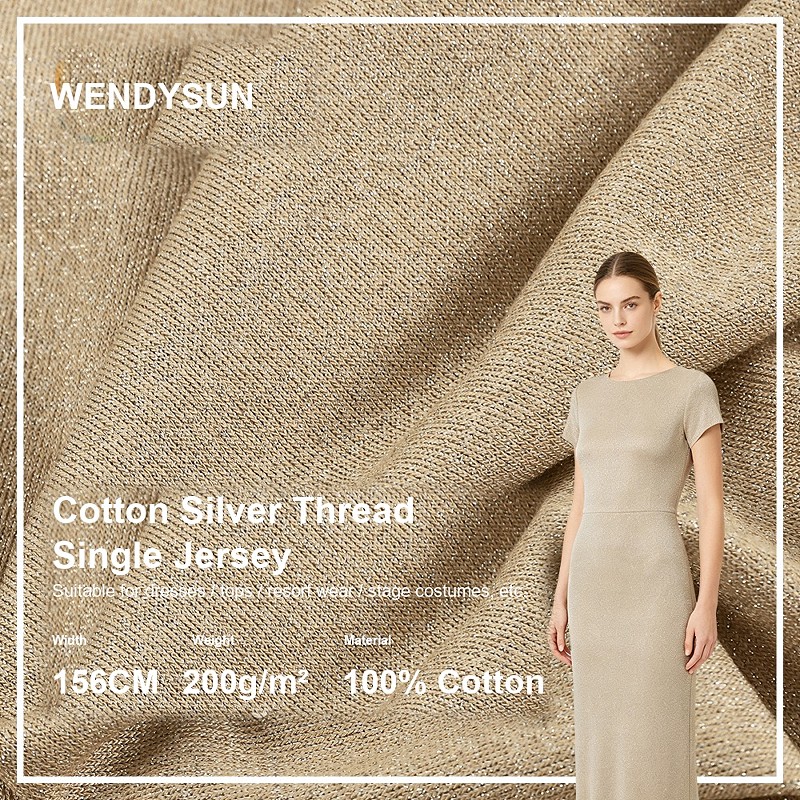
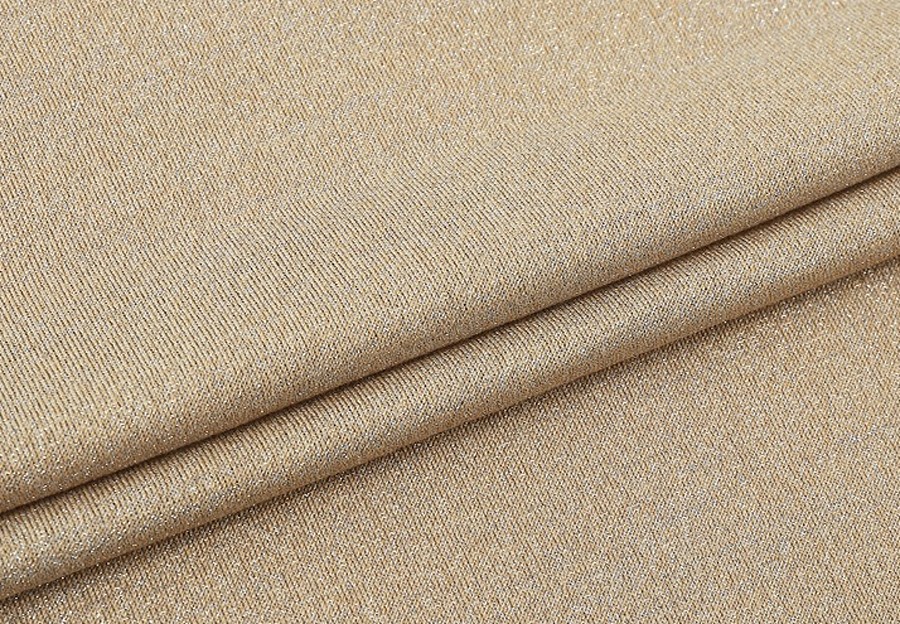
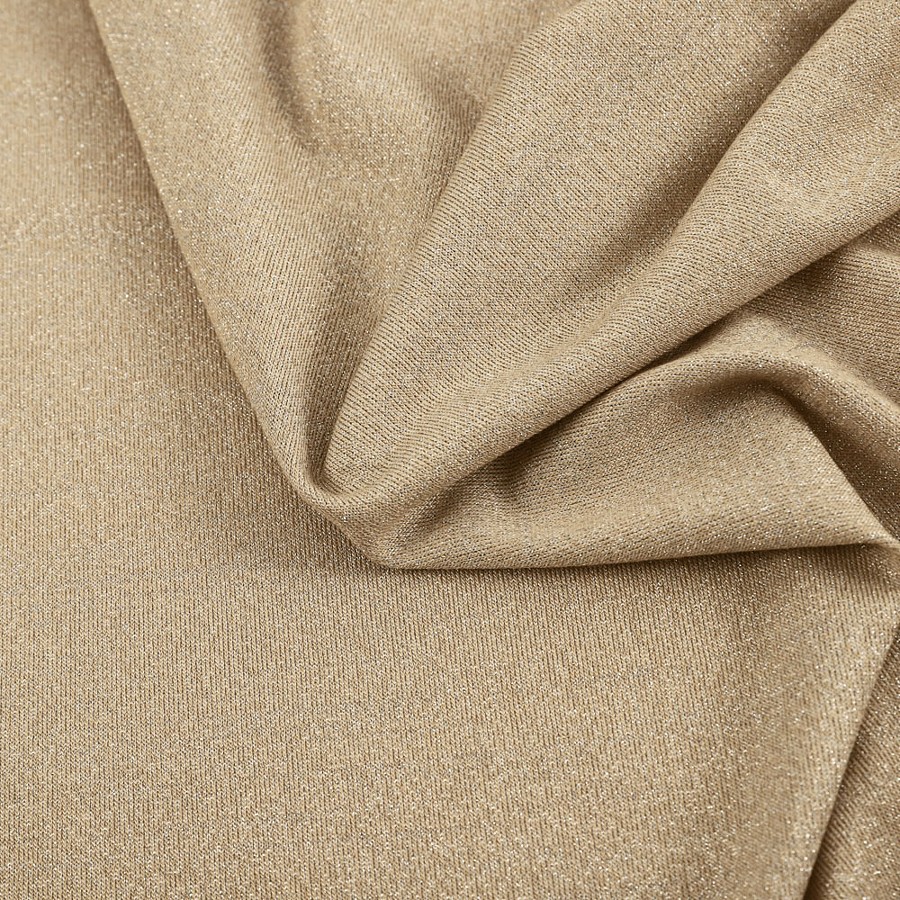
- Composition
- 100% Cottonwith a metallic-lustre fleck
- Weight
- 200 GSM5.9 oz/yd² — a heavy tee jersey
- Width
- 156 cm61 inch, open width
- Structure
- Single jerseyone face, plain knit
- MOQ
- 300 kg≈ 962 running metres
- Colour
- No.001 – No.096quote the shade number
Full specification
| Customization | Available — shade, weight and width confirmed at quotation |
|---|---|
| Knitting technics | Single jersey on a circular machine: one set of needles, one yarn path, plain face on the front and the looped back behind it. The metallic-lustre yarn is knitted in with the cotton, not printed, not coated and not laminated, so the fleck is part of the cloth and does not wash off |
| Composition | 100% cotton as quoted. The silver fleck in the photographs comes from a metallic-lustre yarn running with the cotton — if your label needs an exact fibre breakdown, ask us and we will confirm the percentages for the dye lot in writing before you place the order |
| Yarn | Combed cotton spun for knitting, with the metallic-lustre yarn carried alongside it. Knitted to 200 GSM on the 156 cm width |
| Weight | 200 GSM / 5.9 oz/yd². Heavy for a single jersey — a standard T-shirt body is 160–170 GSM, so this is roughly a fifth heavier, and the difference is opacity and drape rather than warmth |
| Width | 156 cm / 61 inch, open width. Narrower than the 160–165 cm you may be used to: at this weight the cloth pulls in during finishing, and a 30-inch single jersey machine gives around this width once it is relaxed |
| Yarn count | Set at order. Send the count you already run and we knit to it against 200 GSM on the 156 cm width; the price above is on our standard count |
| Stretch | Minimal, and it does not recover. There is no spandex and no elastane core — single jersey gives a little on the cross and then stays where it is put. Cut it as a stable cloth, not as a stretch one |
| Hand | Dry, smooth and slightly cool, with a soft body that reads as substantial rather than thin. The metallic yarn gives it a faint crispness on the surface — it does not feel like a brushed or peach-skin jersey |
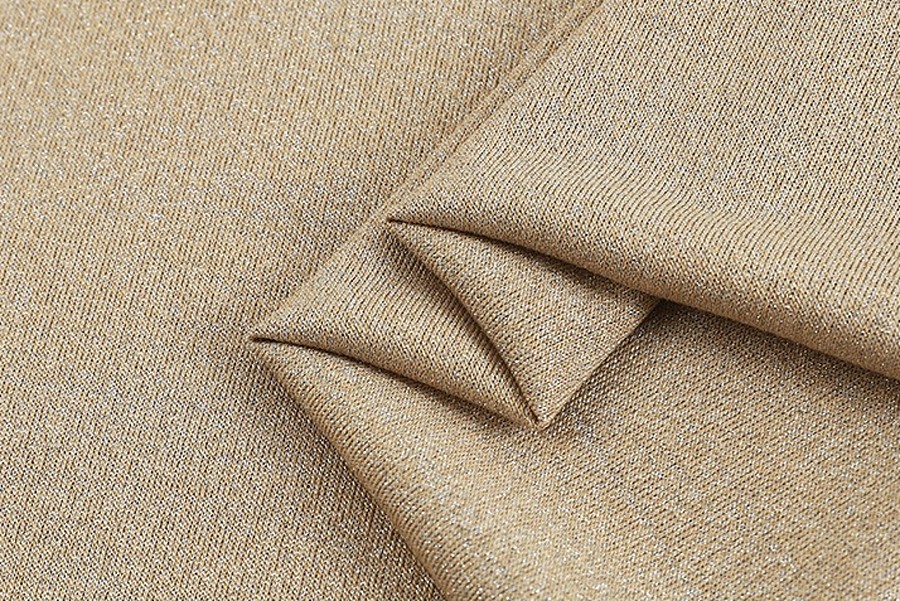
| Surface | Plain single-jersey face with a scattered silver fleck that reads as lustre at arm’s length and as discrete metallic points up close. The back is the usual looped reverse, so an unlined neckline or a rolled hem shows loops rather than the face |
| Colour | Our stock shade card, quoted by number (No.001–No.096), or dyed to order against an approved lab dip |
| Dyeing | Piece dyed after knitting. Cotton takes reactive dye well and dyes level; the metallic yarn does not take the same dye, which is exactly why it stays silver against a dyed ground. That also means the fleck cannot be matched to a Pantone number — approve it as an effect, not as a colour |
| Fastness | Good on wash and on rub for the cotton. The metallic yarn is the part to watch: it dulls under chlorine bleach and under repeated high-temperature washing, so wash cool and skip the bleach |
| Shrinkage | Cotton jersey relaxes on the first wash — expect the usual single-jersey movement, and pre-shrink or relax the roll before cutting. Metallic yarn does not shrink with the cotton, so a panel cut tight will pull at the seams after washing |
| Pilling | Low to moderate. Combed cotton on a plain face pills less than a carded loop, but cotton is a short-staple fibre and some surface fuzz is normal on a knit that is worn and washed hard |
| The fleck is the point of the cloth, so all-over print fights it. Solid shades, tonal embroidery, a small chest print and screen print on the reverse all work. Plastisol sits on the face and visually flattens the fleck; a soft-hand water-based ink keeps the surface reading as cloth | |
| Making up | Ball-point needle, 75–80, and a light needle tension. The metallic yarn is the weakest element in the seam: a burr on the needle or a hot needle will snag and pull it. Overlock with the differential feed set slightly positive so the seam does not ripple, and do not run the machine flat out on a long run |
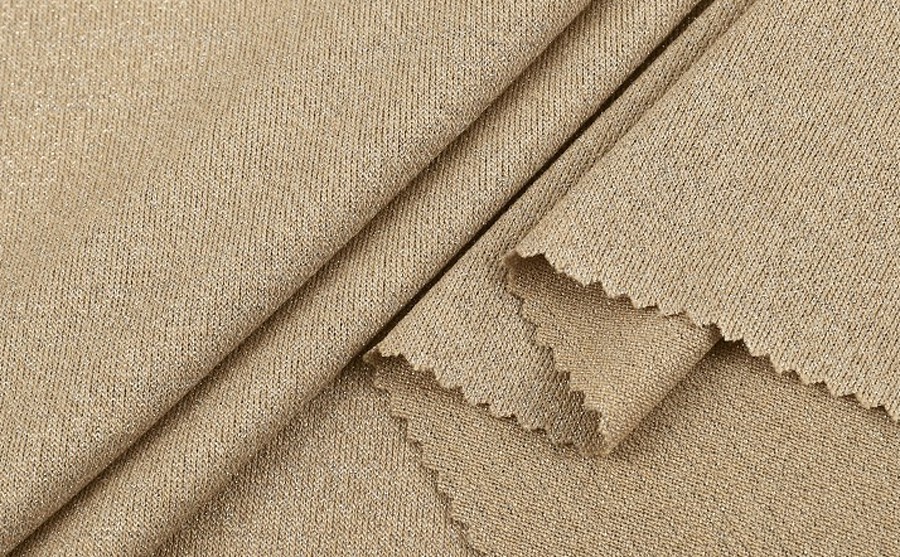
| Cutting | Rotary cut or die cut. Pinked edges hold — the third photograph above shows a pinked swatch with the loops intact — so raw-edge and unhemmed details are safe on this quality |
| Origin | Shaoxing City, Zhejiang, China |
| MOQ | 300 kg per shade |
| Price | US$ 30.17 / kg (300–999 kg) · US$ 27.46 / kg (1,000 kg+) |
| Yield | ≈ 3.21 running metres per kg at 200 GSM × 156 cm (≈ US$ 9.41 per running metre, ≈ US$ 6.03 per m²) |
| Lead time | Stock shades ship from the dye lot on hand; dyed-to-order shades are confirmed at quotation |
| Packing | Roll-packed, roughly 20 kg per roll, poly bag inside a woven sack |
| Sample | Hanger swatch free; a 1 m cut of a stock shade charged at cost and credited against the bulk order |
| Documents | Invoice, packing list, B/L, certificate of origin; test reports on request |
| Care | Machine wash cool (30°C) on a gentle cycle, do not bleach, do not tumble dry hot, dry flat in shade, cool iron on the reverse with a cloth, do not dry clean |
Why 200 GSM and not 160
The weight ladder in single jersey is short and everyone knows where the rungs are: 140–150 GSM is a promotional T-shirt, 160–170 is the standard retail tee, 180 is a heavier tee, and 200 and above is where the cloth stops behaving like a T-shirt and starts behaving like a garment.
At 200 GSM you get opacity for free. A white or sand tee in 160 GSM shows the outline of what is underneath and needs a second layer or a heavier gauge of yarn to hide it. This quality hides it in one layer, which is why it is used as a body fabric rather than as a print base.
And it drapes rather than clings. Single jersey at this weight has enough mass to hang from the shoulder in a straight line, which is what a slip dress, a wide-leg trouser or a long tunic needs. The same cloth at 160 GSM reads thin and follows every curve, and no amount of pattern work fixes that.
The fleck needs a dense ground. A metallic yarn scattered over a light, open jersey reads as loose sparkle. Knitted into a 200 GSM ground the fleck sits in a closed surface and reads as sheen — a much quieter, more expensive look, and the reason this quality photographs well in a showroom and badly on a phone with the flash on.
The silver thread: what it buys you, and what it costs
The lustre is knitted in. That single decision is what separates this cloth from every cheaper way of getting a shiny surface — a foil transfer, a metallic print, a resin coating, a calendered finish. All four sit on top of the fabric and all four are the first thing to go: foil cracks at the fold, metallic print dulls at the cuff, a coating chalks after ten washes, and a calendered shine disappears the moment the garment is pressed with steam.
In the yarn, the fleck is part of the structure. It is inside the loop, so it does not rub off, it does not crack at a fold line, and a garment made from it still has lustre after a season of wear. That is the whole argument for paying for the real thing.
What it costs you is care, not quality. Metallic yarn is the least robust element in the cloth: chlorine bleach dulls it, a hot iron curls it, a burred needle snags it, and a high-temperature tumble dries it grey. None of that is a defect in the fabric — it is the trade you make for lustre that lasts — but it does belong in the care label and in the brief you give your laundry.
And it cannot be colour-matched. The cotton dyes; the metallic yarn does not take the same dye, which is precisely why it stays silver against a dyed ground. So the fleck is an effect to approve, not a shade to specify: send us the ground shade number and approve the fleck on a hanger swatch, rather than asking for a Pantone match on the sparkle.
156 cm, and the width you are probably used to
Most single jersey arrives at 160–165 cm open width. This one is 156 cm / 61 inch, and it is worth knowing before you price a marker rather than after. At 200 GSM the cloth pulls in during finishing, and a 30-inch single jersey machine gives roughly this width once the roll has relaxed.
In practice that is a few centimetres, and on a T-shirt body it usually changes nothing — two bodies and the sleeves still fit. Where it bites is on a wide panel: a long dress front, a wide-leg trouser leg, a full kimono sleeve. Lay the marker at 156 before you commit, because we cannot make this quality wider: the fleck and the weight set the machine, and stretching the width would change the GSM.
What we can do is match the weight to a width you already run. If your marker is built around 160 cm, tell us at quotation and we will say honestly whether this construction can be knitted slightly wider at the same weight, or whether the answer is a different quality.
Where it goes
Premium-weight T-shirts and long-sleeve tees, undershirts and base layers, loungewear and sleep sets, slip dresses and bias-cut skirts, evening and occasion knits, stage and costume pieces, and the sort of quiet-luxury basics where a solid colour with a faint sheen does the work instead of a print.
It is not the cloth for close-fitting activewear or for anything that has to stretch and recover — there is no spandex here. It is also not a cheap tee base: 200 GSM cotton with a metallic yarn is priced as a fashion quality, and a programme that competes on a $3 T-shirt should be buying 160 GSM plain cotton instead.
Four things that catch people out on a metallic-fleck cotton. No chlorine bleach: it dulls the fleck permanently, and an oxygen bleach is the substitute if a mill insists on whitening. Cool iron, on the reverse, with a cloth: metallic yarn curls and stiffens above about 110°C, and a hot iron pressed straight onto the face leaves a flattened, dull streak that cannot be steamed out. Pre-shrink before cutting: cotton jersey relaxes on the first wash while the metallic yarn does not, so a panel cut tight will pull at the seam after washing rather than before. Keep a retained standard: the fleck is an effect and effects drift between dye lots — approve a hanger swatch and hold a piece of the bulk against it for every repeat.
Ask for the shade card and a price
Send the ground shade numbers you are choosing between, the quantity in kilos and what you are cutting. We reply within one working day with the price, what is on the dye lot, and a hanger swatch of the fleck so you can put it next to your own standard before you commit.