Fabrics / Cotton & rayon · Sorona jersey
Sorona Wicking Jersey 160–170 GSM, 175 cm
A 160–170 GSM single jersey knitted from 50% polyester and 50% Sorona on a 175 cm width. It is the weight band of a summer tee, and everything that makes it behave differently from an ordinary polyester tee sits in that second fibre — which is also the part most suppliers leave unexplained.
What the name does not say. The mill, the trade and the poster all call this linen cotton (麻棉). There is no linen in it and there is no cotton: it is half polyester, half Sorona. The name describes the look — dry, matte, a faint irregularity across the face — not a content. We would rather write that down here than have a buyer discover it in a fibre test. If the label has to read linen or cotton, this is the wrong quality and we will say so before you sample it.
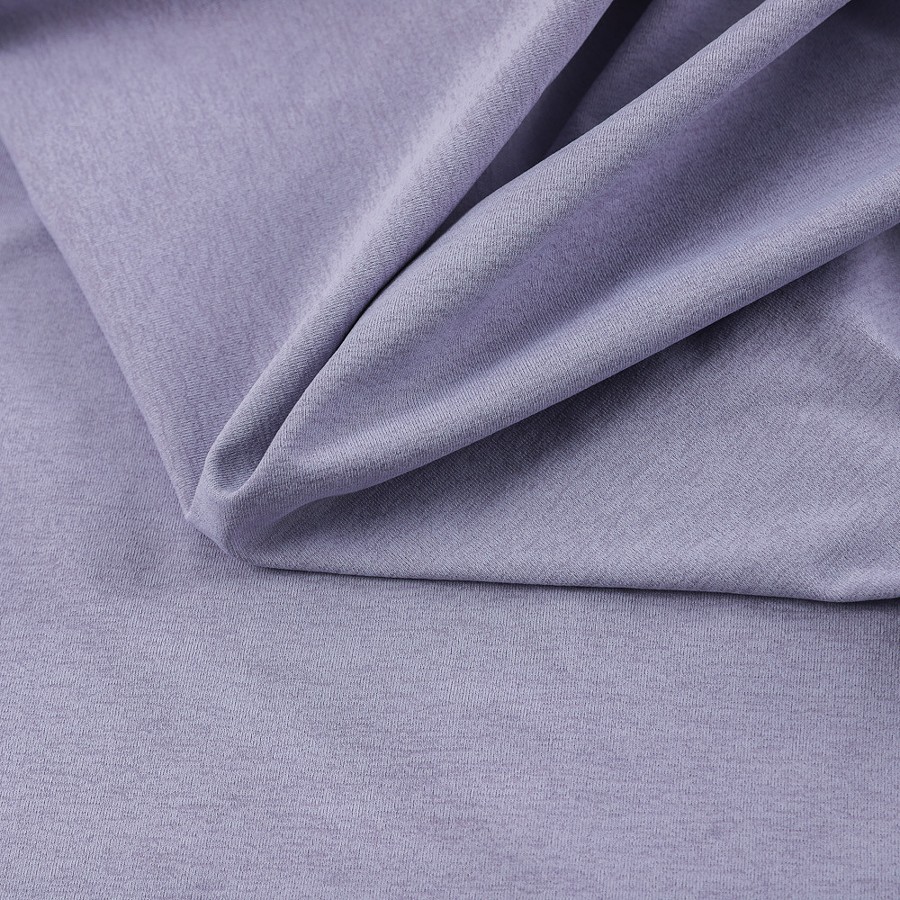
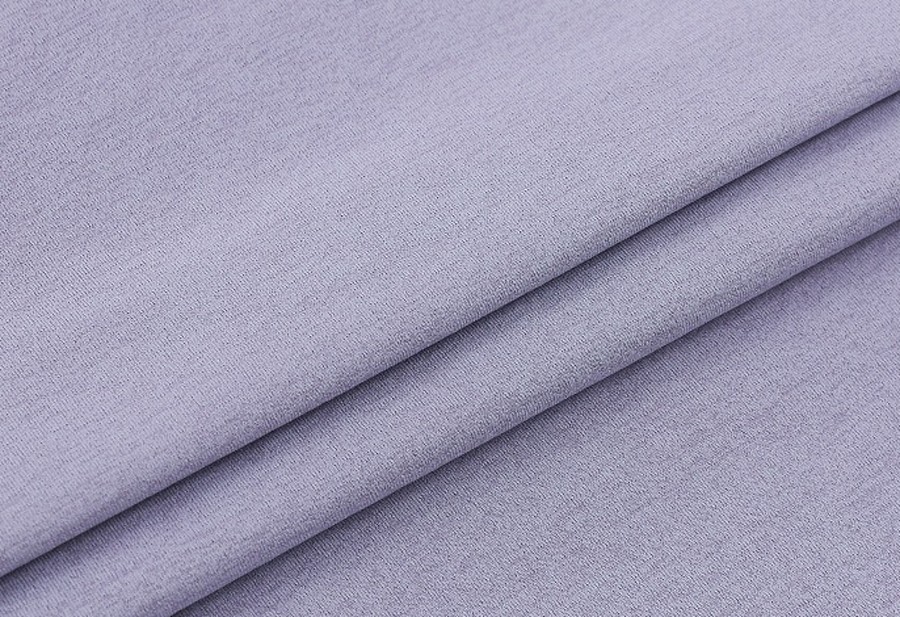
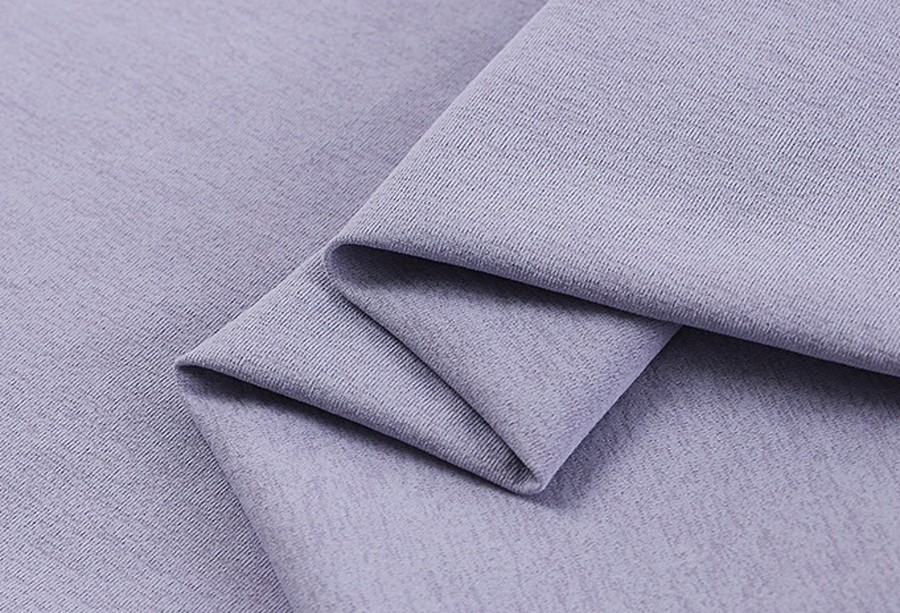
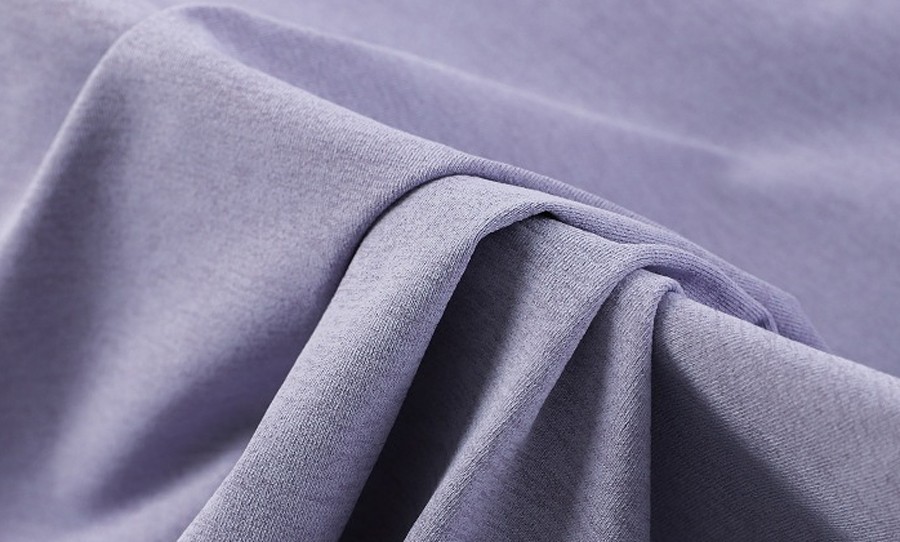
- Composition
- 50% polyester · 50% Soronano linen, no cotton
- Weight
- 160–170 GSM4.7–5.0 oz/yd²
- Width
- 175 cm69 inch — between 160 and 180
- Structure
- Single jersey, fine gaugeone face, no brushing
- MOQ
- 300 kg≈ 1,039 running metres
- Colour
- No.001 – No.096shade card, quoted by number
Full specification
| Customization | Available — shade, weight and width confirmed at quotation |
|---|---|
| Knitting technics | A single-jersey weft knit on a fine-gauge circular machine, then dyed and finished open width. One face, no pile, no coating and no hydrophilic top finish — whatever moves moisture here is the geometry of the loop, which is why it does not wash out |
| Composition | 50% polyester / 50% Sorona (PTT). Sorona is a polyester too, not a spandex and not a polyamide: same family, a different molecular chain, and that chain is what gives the cloth its stretch and its recovery. No linen and no cotton — if a label or a duty code has to declare either, this is the wrong quality |
| Yarn | A spun-look fine count on the face over a filament ground, knitted to 160–170 GSM on 175 cm. The count is set at order |
| Weight | 160–170 GSM / 4.7–5.0 oz/yd². The range is the finished band, not a tolerance we hide in: at this weight a 10 g spread is what a buyer feels as “lighter” or “more substantial”, so name the number you want and we hold it |
| Width | 175 cm / 69 inch, open width. For a tee body that is two fronts and two backs across the width with the sleeves nested between them — the reason this width is worth quoting separately from a 160 cm roll |
| Yarn count | Set at order. Tell us the count your knitter already runs and we match it against 160–170 GSM on 175 cm; the price shown is on our standard count |
| Stretch | About 15–20% with full recovery, and none of it from elastane: the PTT chain itself extends and springs back. That means no spandex to fatigue, to go tacky under heat or to fail in a chlorinated wash — and no spandex price in the cloth. It is not a power stretch; cut it as a soft knit |
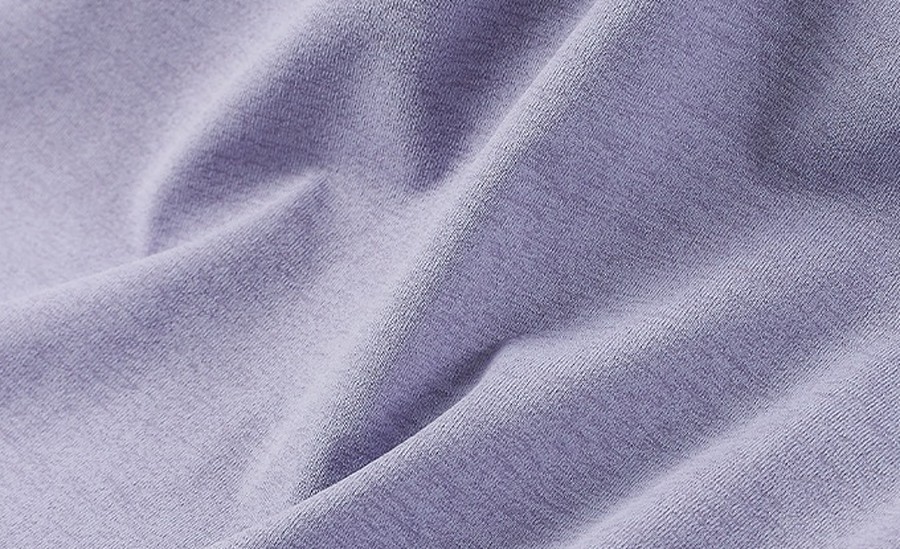
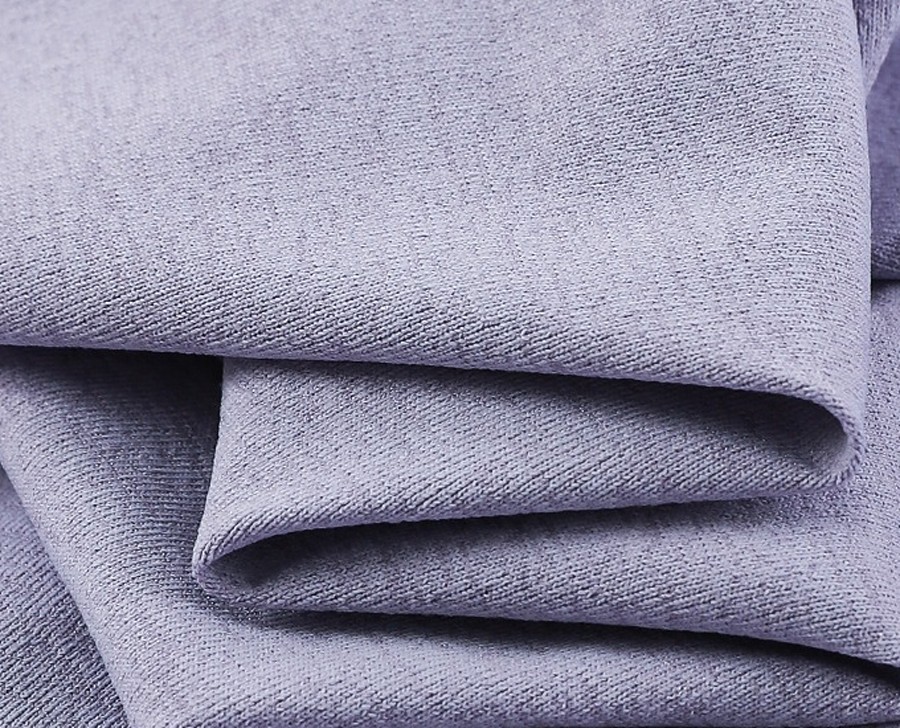
| Hand | Dry, cool and faintly grainy, with the matte look of a linen-cotton and none of linen’s stiffness. Hold it against a plain polyester jersey and the difference is the absence of sheen rather than a difference in weight |
| Surface | A fine, close grain with a faint speckle. That speckle is not a print and not a slub yarn: the two fibres take the same dye to different depths, so the tone varies fibre by fibre. It is also the part that drifts lot to lot, which is why shade approval is per lot |
| Colour | Stock card, quoted by number (No.001–No.096), or dyed to order against an approved lab dip. On a mid tone the speckle reads as depth; on a pale one it reads as a mark — approve the shade on the actual lot |
| Dyeing | Both fibres are dyed in one disperse bath, at a temperature the PTT will take. That is the technical crux of a PET/PTT blend: push the bath to the 130°C a plain polyester wants and the Sorona side loses recovery and goes harsh; run it cool and the polyester side comes up shallow. The two-tone speckle is the visible signature of that compromise |
| Fastness | Good on wash and rub. On a mid-tone lavender the test worth asking for is bleeding into a white adjacent fabric and greying after five washes, not the shade itself |
| Shrinkage | Low in the length, low in the width — a heat-set polyester blend does not move like cotton. Still wash-test before cutting a programme: relaxation on the first wash is normal, and the number belongs in the marker, not in the complaint |
| Pilling | Low to moderate. A fine-gauge filament ground resists pilling; the spun-look face can raise a little at a bag strap or a seat belt in the first washes, then settles. Agree a grade if the garment is a uniform |
| Moisture | Wicking and quick-drying by construction. We do not print a performance number on the page: ask for the test and we run it. The standards a buyer usually names are GB/T 21655.1 for moisture absorption and quick-dry, or AATCC 195 / 199 for liquid moisture management — both need the finished, washed cloth, not the greige |
| Sublimation works, because both fibres are polyester family — but Sorona takes disperse dye at a lower temperature, so a transfer profile tuned for PET comes out lighter and slightly soft on this cloth. Strike off on the actual quality before you commit a print run. Screen print, pigment print and embroidery all sit well on the matte face | |
| Making up | Ball-point or light sharp needle 70–80, standard foot, low presser pressure. Single jersey curls at a raw edge — the curl is predictable and it is towards the face, so a hem, a neckband or a binding has to be allowed for; a raw hem on a jersey is not a design decision, it is a repair |
| Cutting | Rotary or straight knife; the cloth is stable and does not need a paper underlay. Because there is no elastane, do not cut small and stretch to fit — the recovery will pull the seam, not the panel |
| Origin | Shaoxing City, Zhejiang, China |
| MOQ | 300 kg per shade |
| Price | US$ 18.74 / kg (300–999 kg) · US$ 17.36 / kg (1,000 kg+) |
| Yield | ≈ 3.46 running metres per kg at 165 GSM × 175 cm (≈ US$ 5.41 per running metre, ≈ US$ 3.09 per m²) |
| Lead time | Stock shades ship from the dye lot on hand; dyed-to-order shades are confirmed at quotation |
| Packing | Roll-packed, roughly 20 kg per roll, poly bag inside a woven sack |
| Sample | Hanger swatch free; a 1 m cut of a stock shade charged at cost and credited against the bulk order |
| Documents | Invoice, packing list, B/L, certificate of origin; test reports on request |
| Care | Machine wash cool (30°C), do not bleach, tumble dry low or line dry, cool iron on the reverse (150°C max), no fabric softener |
Sorona is a polyester, not a spandex — and that is the point
Buyers hear “stretch” and assume elastane. There is none in this cloth. Sorona is a PTT — a polyester with a different chain — and that chain stores and returns extension on its own, so the stretch lives in the fibre instead of in an additive.
What that buys you on a tee. An elastane knit loses its recovery in two places: heat and time. A pad-dry-cure that runs hot, a dye cycle at 130°C, or eighteen months in a warehouse and the spandex has quietly gone soft — which is why a two-year-old stretch tee bags at the seat and the elbow while the fabric still looks new. A PTT body does not have that part to lose. It also survives a chlorinated wash and does not go tacky under a hot iron.
What it does not buy. Power. Fifteen to twenty percent with recovery is a soft knit, not a compression knit; cut the ease in and let the cloth do what it does. And because PTT softens lower than PET, the finishing temperature is not a detail — see the four notes at the end of this page, where a hot tenter costs you the recovery you just paid for.
It reads as linen without linen’s bill
The look is honest: dry, matte, slightly irregular, no sheen where the light hits a fold. What a buyer actually wants when they ask for a linen-cotton jersey is usually three things — that look, a cool dry hand, and none of the maintenance — and this cloth gives all three without the fibre.
The three things linen charges for. Creasing that no steamer really fixes. A first wash that moves the panel 4–6%. And slubs that pill where a bag rubs, on a cloth that already costs more per kilo than most jerseys. A heat-set polyester blend holds its panel size, drops its creases on the hanger and costs what a polyester blend costs.
What you give up. Linen’s crispness — this cloth drapes rather than stands — and the fibre story on the hangtag. If the range is sold on “natural fibres”, be straight with your customer: the honest version of this fabric’s story is a tee that keeps its shape and dries fast, not a plant fibre.
Wicking is a construction here, not a coating
Plenty of “quick dry” jersey is ordinary polyester with a hydrophilic finish padded onto it. It tests well in the lab, then goes home with the customer, gets washed five times with a softener and stops wicking — because the finish was on the surface and the softener covered it.
There is no finish on this cloth. A fine-gauge single jersey already forms capillary channels between the loops, and the flat filament ground carries liquid along them; the dry spun-look face spreads it out so it evaporates instead of sitting in a patch. Nothing added means nothing to wash off — but it also means the performance is built in at the knitting machine, so the gauge and the yarn count matter more than any after-treatment.
Ask for the number, do not print it. If the garment hangs a “quick dry” claim, get the test on the finished, washed cloth: GB/T 21655.1 for moisture absorption and quick-dry, or AATCC 195 / 199 for liquid moisture management. We will run it against the standard you name and send the report; what we will not do is put a figure on this page that came from a different lab, a different shade or a greige sample.
175 cm, and what a 300 kg minimum actually makes
At 165 GSM on 175 cm a running metre weighs about 289 g, so a kilo runs about 3.46 metres and a 300 kg minimum is roughly 1,039 metres. A basic tee takes something like 0.6–0.7 m of this width once the sleeves are nested — put together, the minimum is in the region of 1,500 pieces. That is the number to check against your first order before the price matters.
175 cm sits between the 160 cm roll most knitters quote and the 180 cm we run on the birdseye. For a tee it is the useful middle: front and back body across, sleeves in the gaps, a collar band off the end of the lay. If your marker was built on 160 cm, lay it again — the saving usually shows up as a shorter lay rather than a cheaper kilo.
Four things that go wrong on a PTT blend. Heat: PTT softens well below PET, so a tenter over about 170°C or an iron over 150°C costs the recovery and gives a papery hand. Sublimation: both fibres are polyester family, but Sorona takes disperse dye cooler, so a print profile built for PET comes out light and soft — strike off first. Softener: a silicone softener in a garment wash covers the capillary surface and the wicking is gone in one cycle. Lot speckle: the two-tone depth drifts between dye lots; approve on the lot, not on a colour card.
Ask for a swatch, a test report or a price
Tell us the shade number, the weight of the programme in kilos and what you are cutting — tees, polos, dresses or homewear. We reply within one working day with the price on the lot we hold, the shade card and a hanger swatch. If you need a wicking test for the hangtag, say which standard and we quote it with the cloth.
Related: for the winter version of the same “soft hand, no wool” idea see the Sheep-Touch Brushed TR Knit 252 GSM; for a heavier cloth that holds its own shape, the TR Air Layer 320 GSM. The rest of the range is on the fabrics page.