Fabrics / Cotton & rayon · Double knit
Acetate-Touch Double-Face 220 GSM, 162 cm
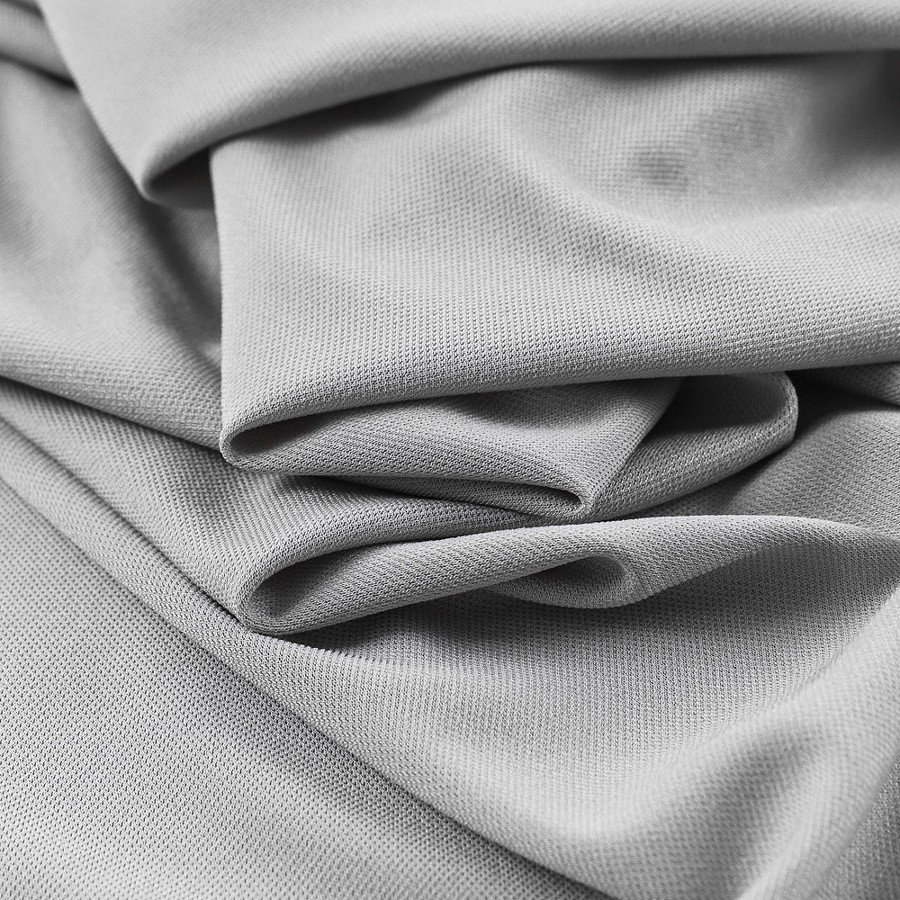
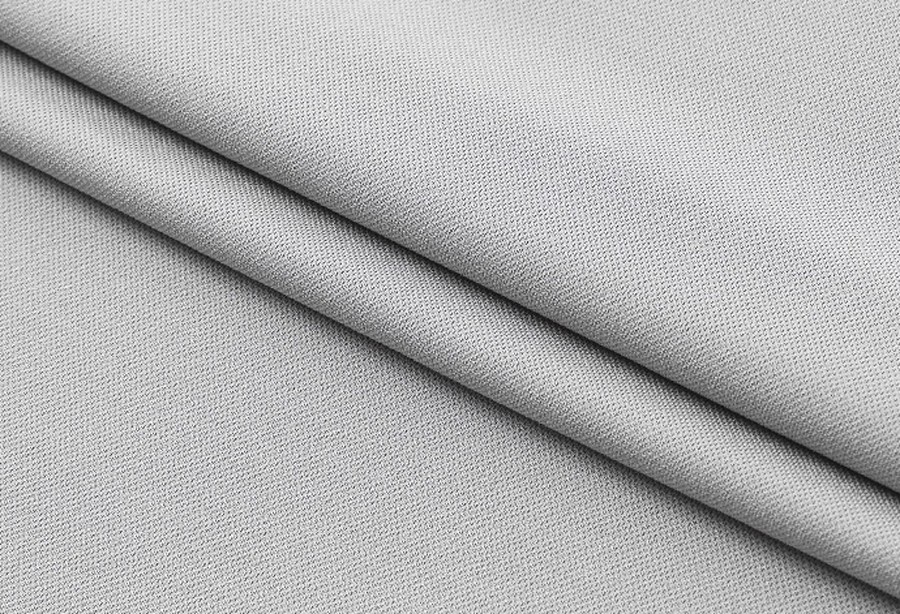
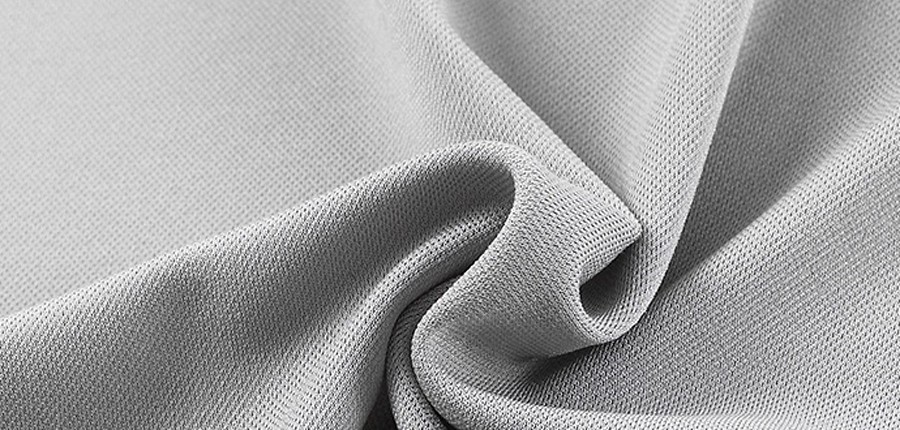
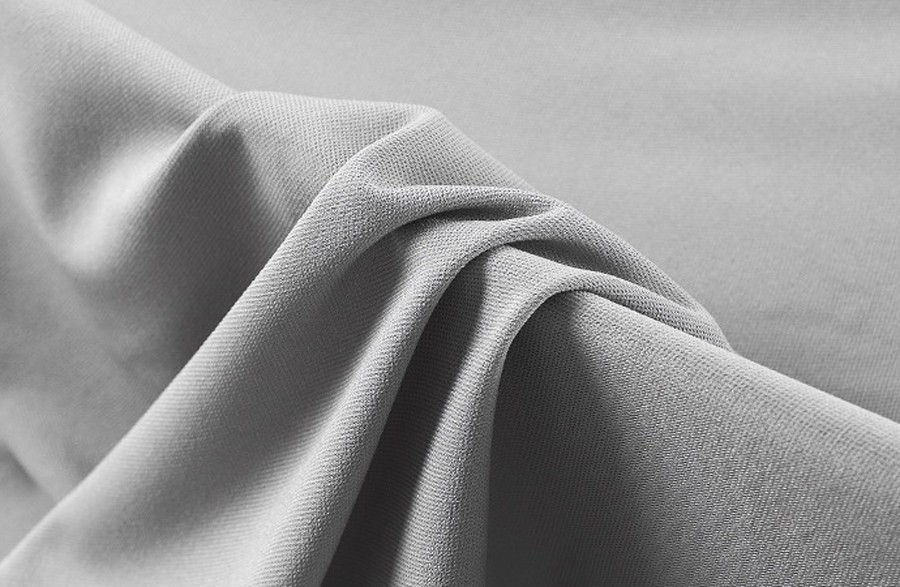
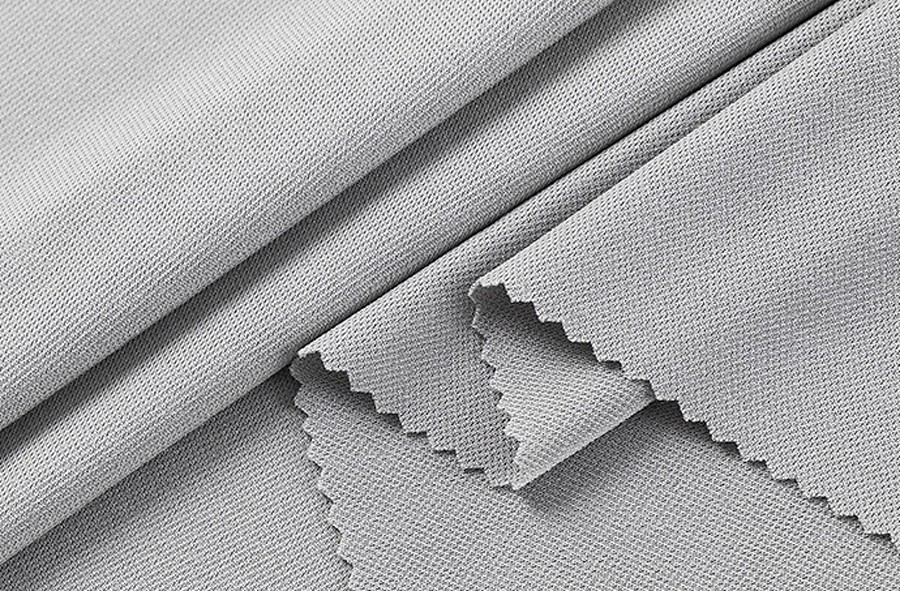
A double knit in a 2:1 poly-viscose on twisted yarn, 220 GSM on a 162 cm width, both faces finished and both faces wearable. The surface is a fine diagonal grain in silver grey, dry to the touch and matte under a light. This is suiting weight sold into dresses, column skirts and unlined jackets — the cloth a designer reaches for when the garment needs to hang without a lining and the budget cannot reach acetate.
On the name. Our poster calls it a rayon acetate-like double face, and that describes the hand, not the bottle. There is viscose in it — a third — and no acetate at all. What the name is pointing at is the dry slide and the way the light sits flat on the surface, which is what acetate does and what an ordinary polyester does not. If your care label has to read acetate, this is the wrong quality and we will say so before you sample. If the label reads polyester/viscose and the brief says “must feel like acetate”, this is the cloth the sentence is asking for, at roughly a third of the fibre cost.
- Composition
- 66.67% polyester / 33.33% viscosea 2:1 poly-viscose, twisted
- Weight
- 220 GSM6.5 oz/yd² — suiting weight
- Width
- 162 cm64 inch — the narrowest in the range
- Structure
- Double knit, twisted yarntwo faces, both wearable
- MOQ
- 300 kg≈ 842 running metres
- Colour
- No.001 – No.096shade card, quoted by number
Full specification
| Customization | Available — shade, weight and width confirmed at quotation |
|---|---|
| Knitting technics | A double knit, run on two needle beds so the two faces are joined by a third set of yarns. Both sides come off the machine finished: there is no wrong side, no raised back to brush and no lining needed to hide the reverse. It is a circular knit, not a woven cloth — the cloth gives in the cross direction and recovers, which a woven suiting does not |
| Twisting | The yarn is twisted before knitting, and this is the single thing that separates the quality from an ordinary poly-viscose. Untwisted, a 2:1 poly-viscose reads synthetic: it shines, it feels slick, and it pills where it rubs. Twist binds the fibre ends into the yarn, so the surface stays matte and dry, the light breaks up instead of bouncing, and the cloth resists pilling without a brushing or a coating. The cost of twist is a doubling machine and a slower spin — which is part of why this quality sits above a plain poly-viscose at the same weight |
| Composition | 66.67% polyester, 33.33% viscose — a 2:1 ratio, which is the standard poly-viscose balance and not an arbitrary figure. The polyester carries strength, crease recovery and shape retention; the viscose carries moisture regain, softness and drape. Two parts polyester is what keeps a jacket from collapsing; one part viscose is what keeps it from feeling like a plastic bag. No elastane, no wool, no cotton. The figures are the actual feed ratio, which is why they are written to two decimals rather than rounded to 67/33 |
| Face and back | Same colour both sides, same grain, same hand. On this quality the two faces differ only in that one is very slightly denser, which is a machine side rather than a design: either face can be the outside. Confirm which face the buyer wants as the face before bulk, and mark it on the sample roll, because the difference is real under a light box even when it is invisible on a hanger |
| Yarn | Twisted filament polyester in the face and back, twisted spun viscose blended in for the hand. Filament gives the strength and the clean surface; the viscose spun component gives the dry touch and takes the dye. Counts are set at order |
| Yarn count | Set at order |
| Weight | 220 GSM / 6.5 oz/yd². Suiting weight: heavy enough that a dress hangs from the shoulder without a lining and a light jacket holds a clean lapel, light enough to wear indoors in summer. We hold the single figure rather than a band |
| Width | 162 cm / 64 inch, open width. The narrowest width in the cotton and rayon range, and that has a cost consequence — read the marker note below before you price a garment |
| Colour | Stock card, quoted by number (No.001–No.096), or dyed to order against an approved lab dip. This quality is shown in a silver grey. On a twisted yarn the shade has to be approved on the twisted yarn: twist changes how the dye strikes, so a lab dip made on a flat yarn will not match the bulk |
| Dyeing | Piece-dyed on a carrier route for a polyester-heavy blend, then heat-set. The viscose takes the dye readily and the polyester needs the carrier, which is why the shade is built in two stages and why a two-tone cast can appear if the stage temperatures drift. Ask for the lot-to-lot shade band on the colour you will actually run, not on a colour card |
| Hand | Dry, cool and faintly granular on the face — the twist is what you feel. It has none of the slick, slightly clammy hand of an untwisted polyester, and it does not have the peach softness of a brushed cloth. What it does have is the dry slide of an acetate, which is where the name comes from |
| Drape | Fluid for 220 GSM, with weight behind it. The viscose pulls it down and the double-knit structure keeps it from collapsing, so a wide skirt falls in a line rather than a cone. This is the reason the quality sells into dresses, column skirts and unlined jackets |
| Stretch | No elastane, but a double knit gives roughly 10–15% cross-wise stretch from the structure alone, and it recovers. Cut it as a stable cloth, not as a stretch cloth: a pattern drafted with negative ease will sit right, a pattern drafted for elastane will be loose after a day |
| Shrinkage | 2–3% after heat-setting, on both directions, which is tight for a poly-viscose and is one of the things the heat-setting buys. Wash-test a panel anyway: the figure holds for a relaxed roll, and a roll that has been stored under tension will move more on the first cut |
| Pilling | Good — grade 4 or better on the random-tumble test, which is unusual for a poly-viscose and comes directly from the twist. An untwisted 2:1 blend of the same weight pills at 2–3, and pilling is the complaint that ends a uniform programme. Name the grade on the tech pack |
| Fastness | Good on light and on wet rub for a mid-shade; the risk on this blend is not crocking but shade drift between lots, because the polyester and the viscose are dyed in separate stages. Ask for the lot shade band and keep the approved bulk standard |
| Heat setting | The cloth is heat-set after dyeing, which is what fixes the width, the flat surface and the low shrinkage. It also means heat is the enemy afterwards: a press above 160°C will glaze the polyester permanently, and a glazed patch on a matte cloth reads as a stain rather than a shine |
| Making up | Sew it as a stable knit: a fine ball-point or a 70 sharp, a light tension, and a seam that stretches with the cloth — a straight lockstitch on a cross-wise seam will crack. Because there is no wrong side, every seam allowance is visible from one face or the other: overlock and press it flat, or use a French seam on unlined pieces. Do not interface the front of a jacket with a fusible that needs high heat; use a low-temperature fusible or a sew-in |
| Cutting | One-way lay if the shade is at all directional — on a twisted yarn a panel cut the other way up can read a tone lighter under a shop light. At 162 cm the marker is the constraint: a dress panel and a sleeve will not nest side by side, so a garment that drapes two full widths per piece wastes more than the width suggests |
| Abrasion | The twist protects the surface, so abrasion resistance is good for a knit — but a glazed press or a hot iron is the real risk, not wear. On a silver grey, any glaze shows as a lighter patch. Press through a cloth, on the reverse, at 150°C |
| Pressing | Medium heat, 150°C, steam, through a press cloth. Never press dry and never let an iron sit: polyester glazes at around 160°C and the glaze does not come out. Steam the garment on a hanger rather than pressing the face |
| Origin | Shaoxing City, Zhejiang, China |
| MOQ | 300 kg per shade |
| Price | US$ 18.74 / kg (300–999 kg) · US$ 17.36 / kg (1,000 kg+) |
| Yield | ≈ 2.81 running metres per kg at 220 GSM × 162 cm (≈ US$ 6.68 per running metre, ≈ US$ 4.12 per m²) |
| Lead time | Stock shades ship from the dye lot on hand; dyed-to-order shades are confirmed at quotation |
| Packing | Roll-packed, roughly 20 kg per roll, poly bag inside a woven sack |
| Sample | Hanger swatch free; a 1 m cut of a stock shade charged at cost and credited against the bulk order |
| Documents | Invoice, packing list, B/L, certificate of origin; test reports on request |
| Care | Machine wash cool (30°C), gentle cycle, mild detergent, no chlorine bleach, no fabric softener — softener fills the twist and the dry hand never comes back. Tumble on low or hang to dry; press warm on the reverse through a cloth. Do not iron the face directly and do not dry-clean in a solvent that runs hot |
Why this does not feel like polyester: the twist
Take the same 2:1 poly-viscose, the same 220 GSM, the same machine, and skip the twisting: the cloth comes out bright, slick and slightly clammy, and it pills at the cuff within a month. Put the twist in and the same blend reads matte, dry and quiet. Nothing was added and nothing was coated — the fibre ends that would have worked their way to the surface are bound into the yarn instead.
What it costs. A doubling machine, a slower spin and a higher yarn price, which is why a twisted double knit sits above a plain poly-viscose at the same weight. What it buys is the two things that end a programme: pilling and shine. On the random-tumble test this quality runs grade 4 or better; the untwisted version of the same blend runs 2–3. Put the number on the tech pack rather than the adjective.
Two faces, and what that saves in the factory
A double knit is two cloths joined by a third set of yarns on two needle beds, and both faces come off the machine finished. Practically, that means three savings that a costing sheet should show: no lining on the body of a dress or a soft jacket, no separate back-cloth to buy and join, and one fewer operation at the sewing floor. On a column dress the lining alone is often 25–35% of the fabric cost, so the double face is not an expensive cloth — it is a cloth that removes a cost.
The trap is the seam allowance. With no wrong side, every allowance is visible from one face or the other: overlock and press it flat, or French-seam the unlined pieces. And the two faces are not identical — one is a hair denser — so decide which face is the face before bulk and mark it on the sample roll. Under a light box the difference is visible; on a hanger it is not, which is exactly how a shipment gets refused for a reason nobody saw at approval.
Silver grey, and the shade risk that comes with two fibres
A 2:1 blend is dyed in two stages — the viscose takes the dyestuff readily, the polyester needs a carrier — so the shade is built rather than struck. Get the stage temperatures right and you get a clean, even silver grey with no cross-cast; let them drift and you get a fabric that looks slightly lilac under daylight and slightly green under tungsten, which is the most expensive kind of complaint because it is invisible on the approved swatch.
Two things to ask for, in this order. First, approve the lab dip on twisted yarn, not on a flat-yarn dip — twist changes how the dye strikes, so a dip made on flat yarn will pass and the bulk will not match it. Second, ask for the lot shade band on the colour you will actually run, because mid-greys are where lot-to-lot drift shows worst; black forgives, silver grey does not. Keep the bulk standard on file and check each delivery against it under the same light.
162 cm, and what 300 kg actually makes
At 220 GSM on 162 cm a running metre weighs about 356 g, so a kilo runs about 2.81 metres and the 300 kg minimum is roughly 842 metres. A sleeveless or short-sleeve dress takes 1.5–1.8 m at this width, so the minimum lands around 470–560 dresses; a lined jacket with sleeves takes 2.2–2.6 m and the minimum drops to roughly 320–380 pieces.
The width is the constraint, and it is worth being blunt about it. 162 cm is the narrowest cloth in our range. A dress panel and a sleeve will not nest side by side, and a two-piece suit — jacket plus trouser — does not lay out at all without piecing, so this quality belongs to dresses, skirts and single garments. If the order is a suit programme, a 185 cm width in the same hand is the better conversation, and we would rather say that now than quote a price that fails at the marker.
Four things that go wrong on this cloth. Face choice: the two sides are a hair different — name the face before bulk. Seam allowance: no wrong side, so finish every allowance or it shows. Heat: polyester glazes at about 160°C and the glaze never comes out — press through a cloth. Fabric softener: it fills the twist, and the dry hand and the pilling resistance go with it.
Ask for a swatch, a pilling report or a price
Tell us the shade number, the garment you are cutting and whether the label can read polyester/viscose. We reply within one working day with the price on the lot we hold, the shade card on this quality and a hanger swatch. If the order needs a pilling, shrinkage or lot-shade report, name the standard and we quote it with the cloth.
Related: the same 2:1 poly-viscose in a lighter, softer knit is the Wool-Touch TR Stretch 215 GSM; for a woven cloth that also needs no lining, see the Rayon Jacquard 150 GSM. The rest of the range is on the fabrics page.