Fabrics / Cotton & rayon · TR air layer
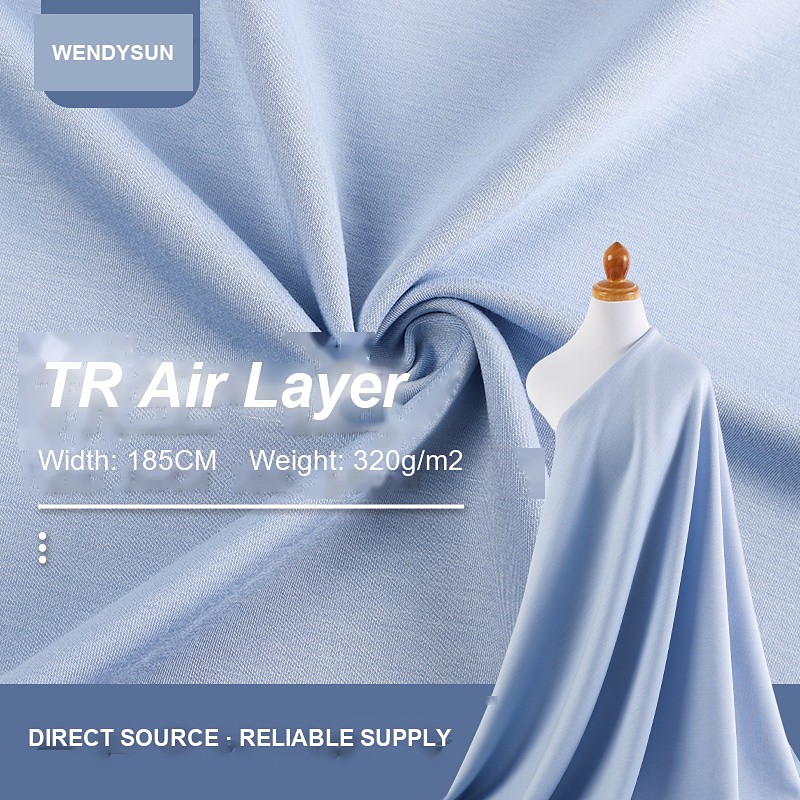
TR Air Layer 320 GSM — Light Blue, 185 cm
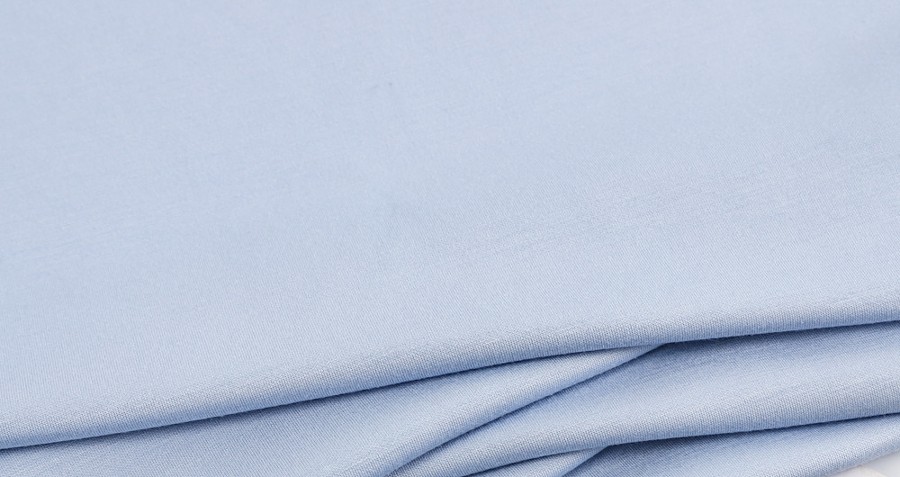
The same 320 GSM three-layer knit in 65% polyester / 35% rayon, on the same 185 cm width, listed here in the light-blue shade we hold in stock — because a pale shade is a different brief from a navy one, and it deserves its own page and its own approval step.
Two lots, two listings. We photograph and price per dye lot, so this page carries the light-blue lot and its price; the navy lot is listed separately on the TR Air Layer 320 GSM page. The cloth is the same. What changes is the shade number you approve — which is the one thing on a pale blue that can still go wrong after everything else is right.
- Composition
- 65% polyester · 35% rayonno cotton, no spandex
- Weight
- 320 GSM9.4 oz/yd² — a heavy three-layer knit
- Width
- 185 cm73 inch — the widest we run
- Structure
- Three-layer air layerface / hollow middle / face
- MOQ
- 300 kg≈ 507 running metres
- Colour
- No.001 – No.096this listing: the light-blue lot
Full specification
| Customization | Available — shade, weight and width confirmed at quotation |
|---|---|
| Knitting technics | A weft knit on a double-jersey circular machine: the two faces are knitted together with a middle yarn that keeps them apart, in one pass. No foam core, no glue film, no quilting stitch — so there is nothing in the cloth that can delaminate, bubble or go flat in a wash |
| Composition | 65% polyester / 35% rayon (viscose). The rayon is what stops the cloth reading as a polyester sweatshirt, and it is also the component that moves in a wash. No cotton, and no elastane — if a label has to declare either, this is the wrong quality and we would rather say so now |
| Yarn | Filament polyester on the two faces with spun rayon in the middle. Knitted to 320 GSM on 185 cm; the count is set at order |
| Weight | 320 GSM / 9.4 oz/yd². The thickness comes from the gap between the faces rather than from a dense yarn, so the panel is thick to the hand and still light on the body |
| Width | 185 cm / 73 inch, open width. On a jacket body that is a full panel plus trim across, and on a sleeve it is two sleeves with almost no waste — worth re-laying a marker you built around 160 cm |
| Yarn count | Set at order. Tell us the count your knitter already runs and we match it against 320 GSM on the 185 cm width; the price quoted here is on our standard count |
| Stretch | None. There is no elastane in the cloth: it compresses softly through the hollow middle but it does not stretch and it does not spring back. Cut the ease in, do not rely on the cloth to give it |
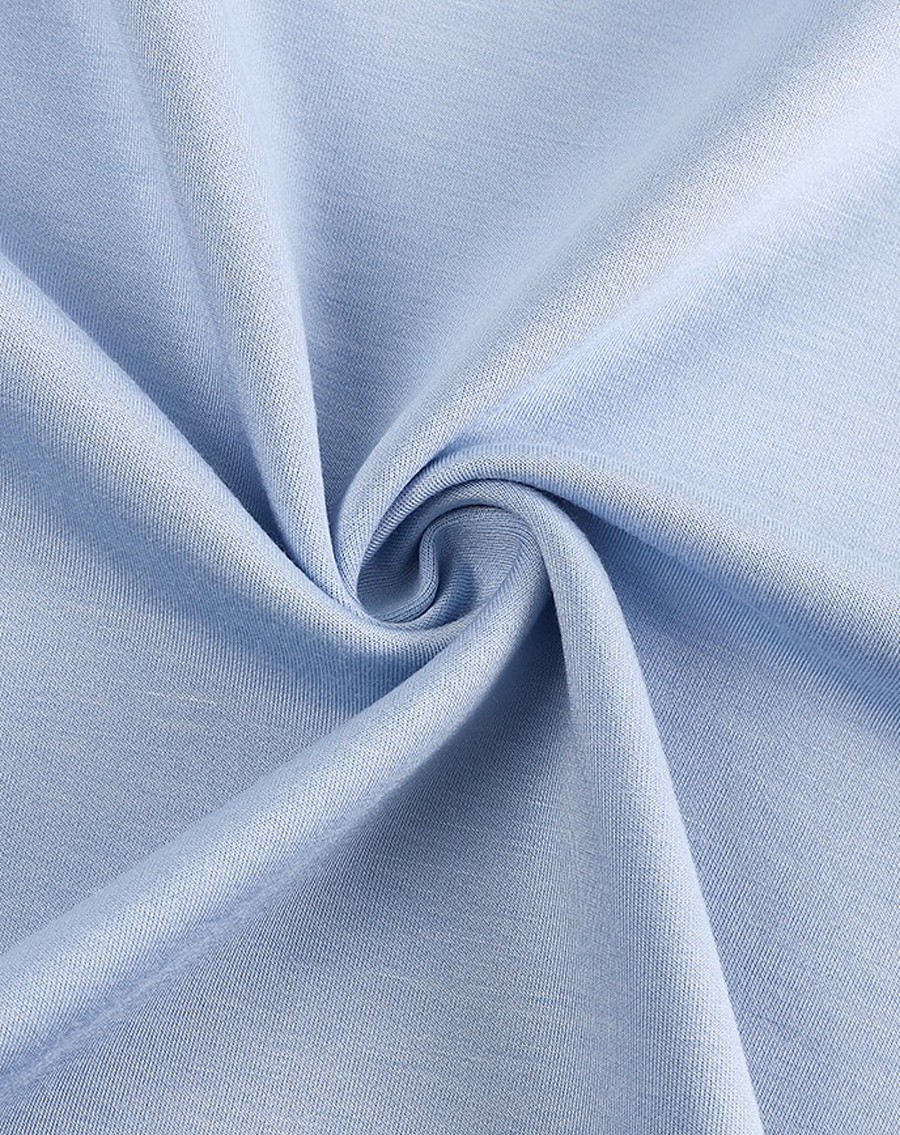
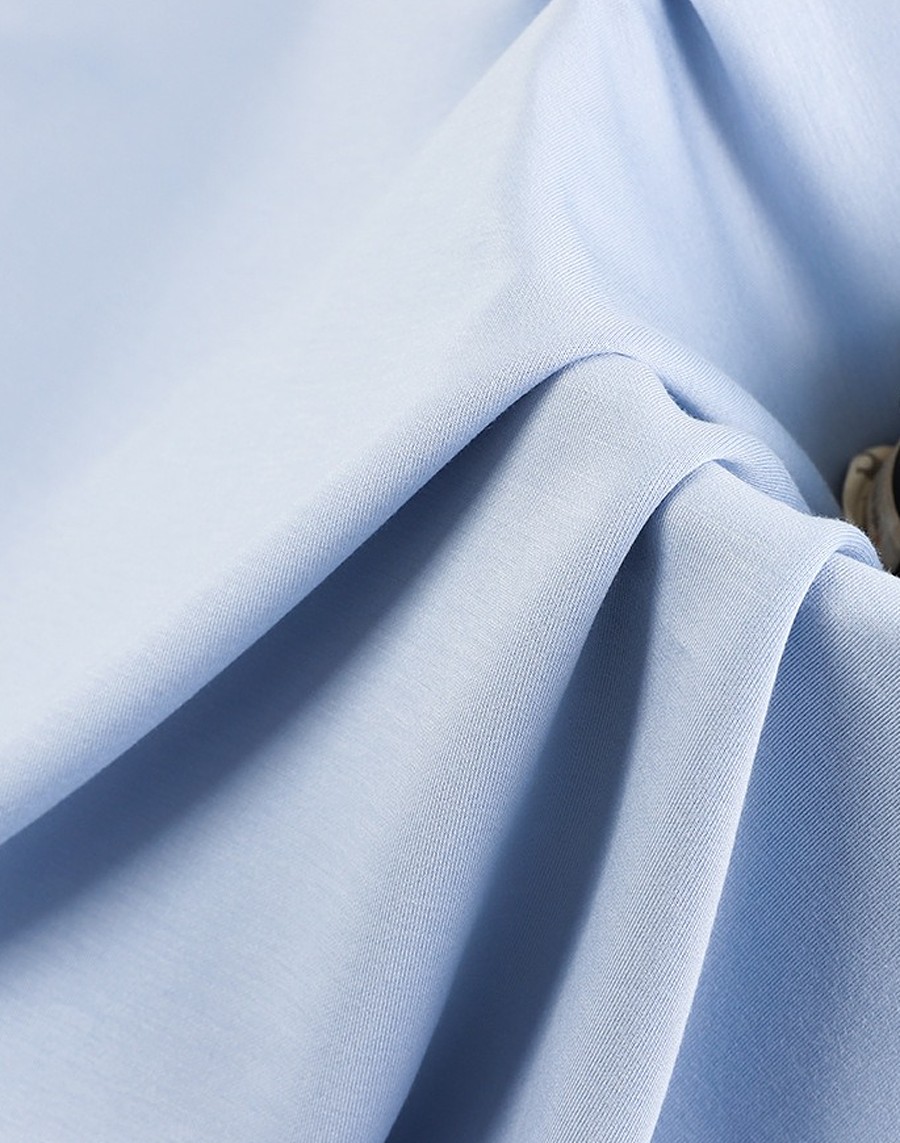
| Hand | Dry and smooth on the face, with a soft, slightly spongy body behind it. It reads closer to a cotton-rich sweatshirt than to a technical shell, which is exactly why it sells in uniform and workwear programmes |
| Surface | Closed and plain on both faces — no eyelets, no pile, no brushed side. The cloth is reversible, so an unlined hood, a raw hem or a contrast facing shows the same clean face inside as out |
| Colour | Stock card, quoted by number (No.001–No.096), or dyed to order against an approved lab dip. This listing is priced on the light-blue lot we hold; shades are quoted per dye lot, so always name the shade number rather than a colour word |
| Dyeing | Piece dyed after knitting, both faces to the same shade. Polyester and rayon need different dye routes, so a TR blend is dyed in two stages to come out level; a mill that runs it as one polyester bath gives a patchy, heathered face |
| Fastness | Good on wash and on rub, which is the test that matters on a pale shade: light blue shows any transfer, any bleeding and any greying at the seam. We test shade and strength after washing, not only before |
| Shrinkage | The rayon relaxes on the first wash and the panel shortens in the length. Relax the roll and wash-test before cutting a uniform programme; add the allowance to the length, because the width is held by the two knitted faces |
| Pilling | Low. Both faces are filament and closed, so there is no short staple on the outside to work loose — the usual cause of pilling on a fleece-backed sweatshirt is simply not there |
| Sublimation is the wrong route: the rayon does not take disperse dye, so a transfer print dyes the polyester and leaves the rayon chalky, which is far more visible on a pale ground than on a dark one. Screen print, pigment print, puff and embroidery all sit well on the closed face — test an all-over print on the actual cloth first | |
| Making up | Ball-point needle 80–90 and a walking foot. Three layers are three layers to feed; a standard foot shifts the bottom face and twists the seam on a long run. Press on the reverse with steam only — a hot iron compresses the middle layer for good and leaves a shine that will not come out |
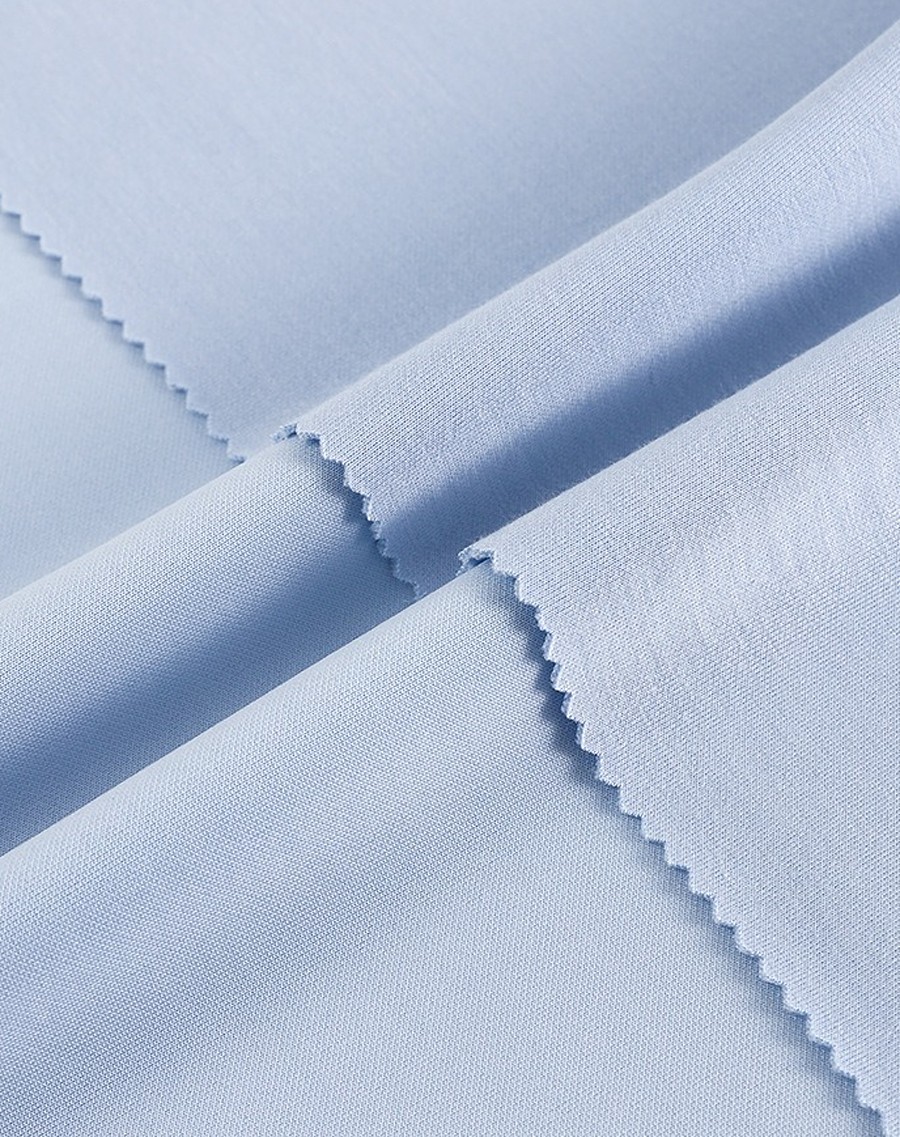
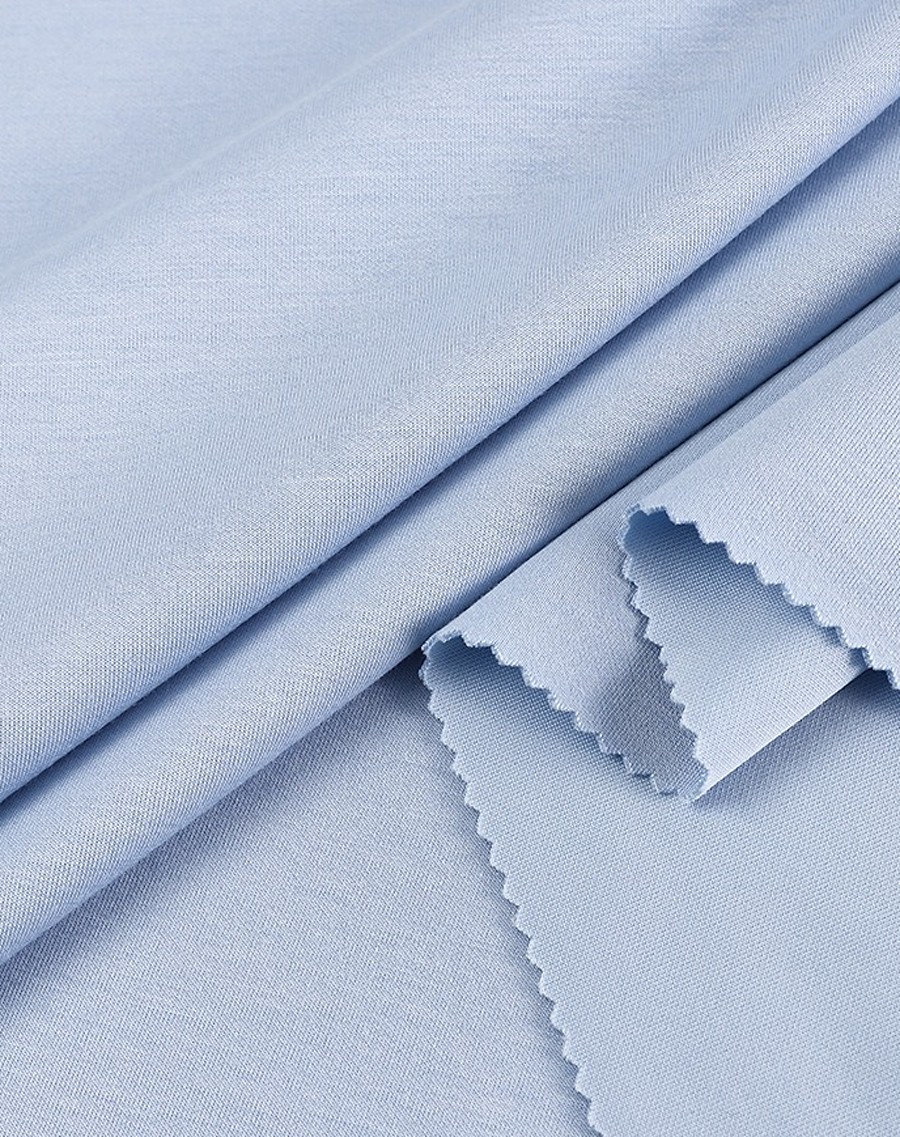
| Cutting | Rotary, pinked or die cut. The layers hold at a cut edge, so raw hems and unlined openings are safe — the photograph below shows the face, the gap and the back face at a pinked corner |
| Origin | Shaoxing City, Zhejiang, China |
| MOQ | 300 kg per shade |
| Price | US$ 15.15 / kg (300–999 kg) · US$ 13.77 / kg (1,000 kg+) |
| Yield | ≈ 1.69 running metres per kg at 320 GSM × 185 cm (≈ US$ 8.97 per running metre, ≈ US$ 4.85 per m²) |
| Lead time | Stock shades ship from the dye lot on hand; dyed-to-order shades are confirmed at quotation |
| Packing | Roll-packed, roughly 20 kg per roll, poly bag inside a woven sack |
| Sample | Hanger swatch free; a 1 m cut of a stock shade charged at cost and credited against the bulk order |
| Documents | Invoice, packing list, B/L, certificate of origin; test reports on request |
| Care | Machine wash cool (30°C), do not bleach, do not tumble dry hot, dry flat in shade, cool iron on the reverse only, do not dry clean |
Why a pale shade needs its own approval step
A navy air layer hides almost everything. A light blue hides almost nothing, and every one of those failures is a shade problem rather than a fabric problem — which means it is caught on a hanger swatch, or it is caught on a finished jacket in front of your customer.
Shade drift shows first. Two dye lots of a pale blue look identical on a computer screen and different on the same rail. Ask for a hanger swatch of the actual lot, check it in daylight and under a colour-matching lamp, and hold a retained piece of the bulk against it for every repeat. On a school or workwear programme where the trousers and the jacket are cut months apart, that retained standard is the only thing that keeps them matching.
Optical brighteners yellow under heat and light. A pale shade is often lifted with a fluorescent whitener, and polyester carries it well — until the roll sits in a sunny warehouse or a factory presses the cloth hot. Keep the roll out of direct light, and do not let a finisher run a high-temperature calendar to “clean up” the face: it yellows the shade and flattens the middle layer at the same time.
Marks read as defects. Needle marks, chalk, oil from a machine bed and a shadow from a crease all disappear on navy and all show on light blue. That is not a reason to avoid the shade — it is a reason to agree the inspection standard before the first roll, not after.
Three layers, and nothing glued between them
Most of what goes wrong with a “thick” knit at this weight goes wrong because it is not knitted thick — it is bonded, foam-backed or quilted. Those three constructions all fail the same way: the foam goes flat, the glue line separates at the fold, the quilting stitches pull. An air layer has none of those parts to fail.
The gap is the product. Two faces, tied by a middle yarn that holds them apart, in a single knitting pass. The still air in that gap is what insulates, so the panel is warm without being heavy, and it stands up on its own because the two faces act as skins — a hood keeps its shape, a bellows pocket reads as a pocket, a hem does not collapse on the hanger.
Built for uniform, workwear and team programmes
This is the quality that ends up as school uniform jackets, workwear mid-layers, baseball and team uniforms, tracksuit tops and hoodies — garments that are issued rather than chosen, worn daily and washed weekly. What that asks of a fabric is different from what a fashion brief asks: consistent shade across repeats, a closed face that does not pill where a bag strap rubs, and a weight that keeps its shape after a season.
Lock three things before you cut. The shade standard, on a retained swatch per dye lot. The shrinkage allowance, measured on a washed test piece rather than assumed. And the seam: three layers need a walking foot and a ball-point needle, or the bottom face shifts and the seam twists over a long run — the fault customers report as a “bad fabric” when it is a machine setting.
For an industrial or high-temperature wash programme, say so at quotation. The cloth handles a normal 30°C wash easily; a 60°C industrial cycle with bleach is a different question, and the answer depends on the shade and on the care label you intend to print, not on the knit alone.
185 cm, and what that does to a marker
185 cm is 25 cm wider than a standard 160 cm roll, and on a jacket body that is the difference between one panel and one panel plus a sleeve. Lay the marker again before you price the style: on a hoodie with a two-piece hood and set-in sleeves, the extra width usually removes a whole metre from every fifth garment, and that is where a cloth at this price actually gets cheaper.
At 320 GSM the roll is heavy — roughly 20 kg per roll — so plan the spreading for it. And because the cloth has no stretch, a panel cut to the pattern stays that size: there is no need to cut small and let it relax out, and no hope of stretching a short panel back.
Four things that go wrong on a pale air layer. Hot pressing: an iron straight on the face compresses the middle layer for good and leaves a shine on light blue that no steam removes — press the reverse, with a cloth. Sunlight in storage: optical brighteners and pale shades shift under UV, so keep the roll bagged and out of the window. Sublimation print: the rayon will not take disperse dye, and the gap shows far more on a pale ground than on a dark one. Mixed lots: two pale lots can differ enough to fail a uniform programme — approve per lot, and keep the retained standard on file.
Ask for the light-blue swatch and a price
Tell us the shade number you are working to, the weight of the programme in kilos and what you are cutting. We reply within one working day with the price on the lot we hold, the shade card, and a hanger swatch of the light blue so you can check it in daylight before you commit.