Fabrics / Cotton & rayon · Brushed TR knit
Sheep-Touch Brushed TR Knit 252 GSM, 185 cm
A 252 GSM brushed knit in 84% polyester / 12% rayon / 4% spandex, on a 185 cm width, with the pile raised on one face and a plain knit left on the other. That single fact — one face brushed, one face not — is what everything else on this page follows from: how the roll is laid, which way the garment is worn, and why the two sides behave like two different cloths.
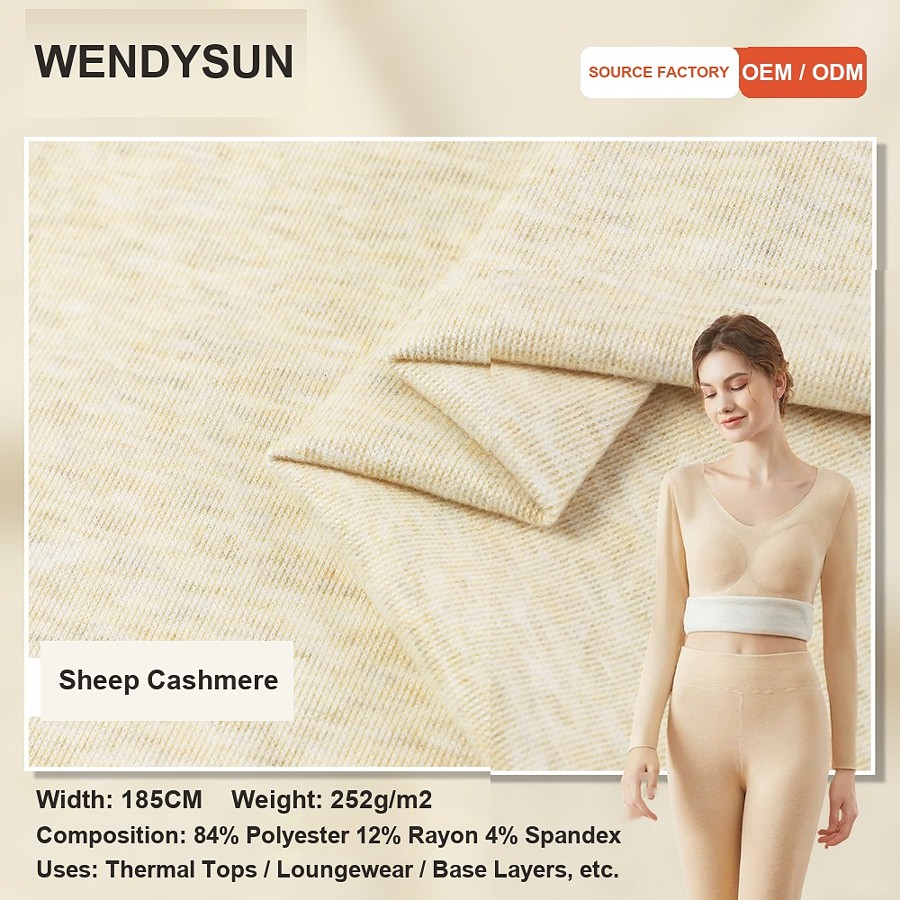
About the name. The trade calls this sheep cashmere, and the poster we print for it says the same. There is no sheep in it: no wool, no cashmere, no animal fibre at all. What the name describes is the hand — a dense, dry, faintly fuzzy surface that reads as cashmere from a metre away and behaves like polyester in a washing machine. We would rather write that down here than have a buyer find it on the care label. If your customer needs a wool label, this is the wrong quality and we will say so before you sample it.
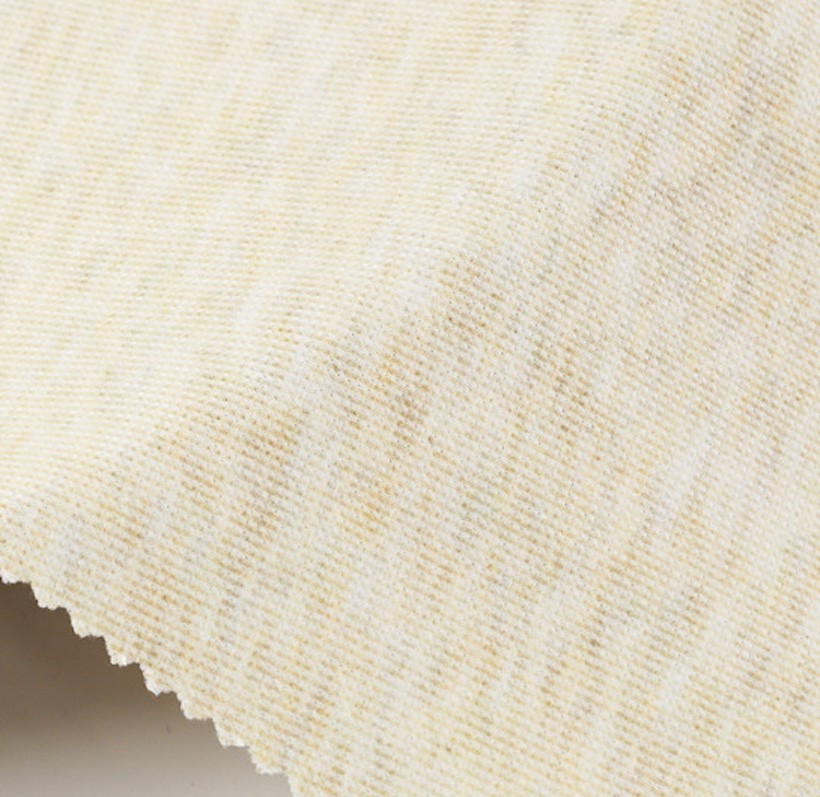
- Composition
- 84% polyester · 12% rayon · 4% spandexno wool, no cotton
- Weight
- 252 GSM7.4 oz/yd² — loft, not density
- Width
- 185 cm73 inch — the widest we run
- Surface
- Single-face brushedpile one side, plain knit the other
- MOQ
- 300 kg≈ 644 running metres
- Colour
- No.001 – No.096shade card, quoted by number
Full specification
| Customization | Available — shade, weight and width confirmed at quotation |
|---|---|
| Knitting technics | A single-jersey weft knit on a circular machine, then raised on one face with wire-covered rollers. The nap is drawn out of the knitted loop itself — nothing is flocked, laminated or glued on, so there is no layer that can separate and no pile that can shed in sheets. The pile is a permanent change to the surface, not a finish |
| Composition | 84% polyester / 12% rayon (viscose) / 4% elastane. The high polyester share is there to hold the brush and keep the shade stable; the rayon softens the hand and takes moisture off the skin; the 4% elastane is what brings the garment back at a knee, an elbow or a seat. No wool and no cotton — if a label has to declare either, this is the wrong quality |
| Yarn | Filament polyester with spun rayon, knitted to 252 GSM on a 185 cm width. The count is set at order, against the weight you need |
| Weight | 252 GSM / 7.4 oz/yd². The weight is in the loft: the same yarn is raised into a pile rather than packed into a denser loop, so the panel feels thick and still hangs light. It is the weight band of a thermal base layer, not of a fleece |
| Width | 185 cm / 73 inch, open width. On a base-layer body that is a full front panel plus a sleeve across, and on sleeves it is two sleeves with very little waste. If your marker was built around 160 cm, lay it again before you quote the style |
| Yarn count | Set at order. Tell us the count your knitter already runs and we match it against 252 GSM on 185 cm; the price shown is on our standard count |
| Stretch | About 4% elastane, which is recovery rather than compression. The cloth follows the body and comes back — it will not hold a shape on its own the way a 15% spandex power knit does, so treat it as a soft knit and cut the ease in |
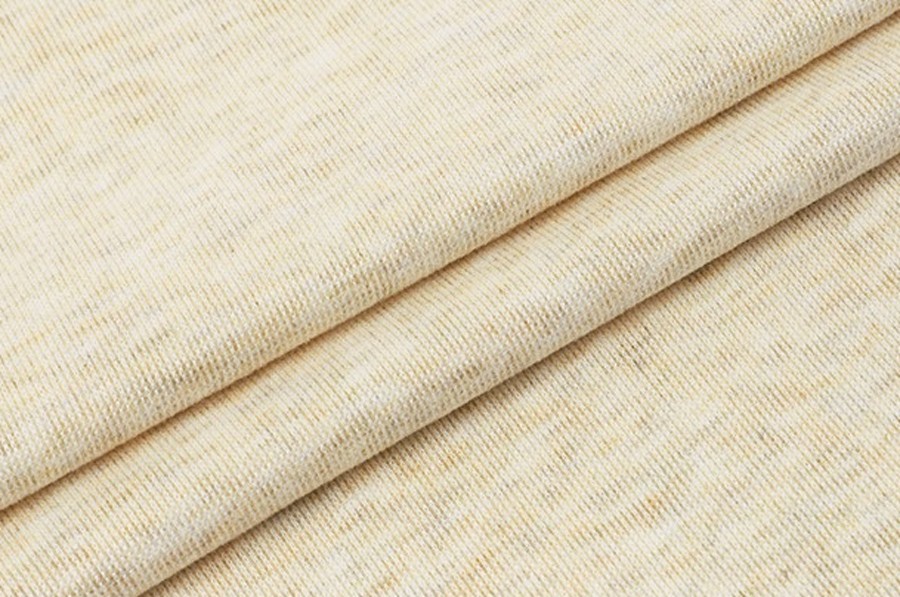
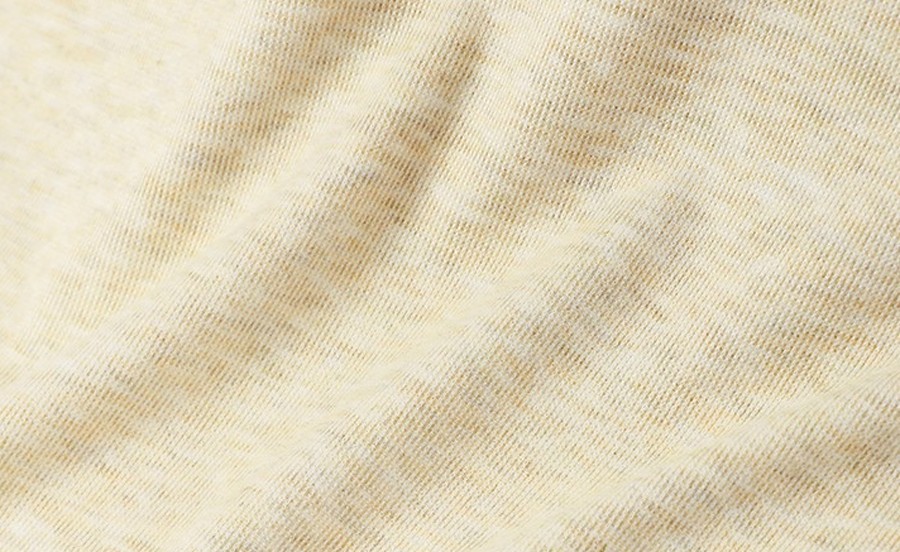
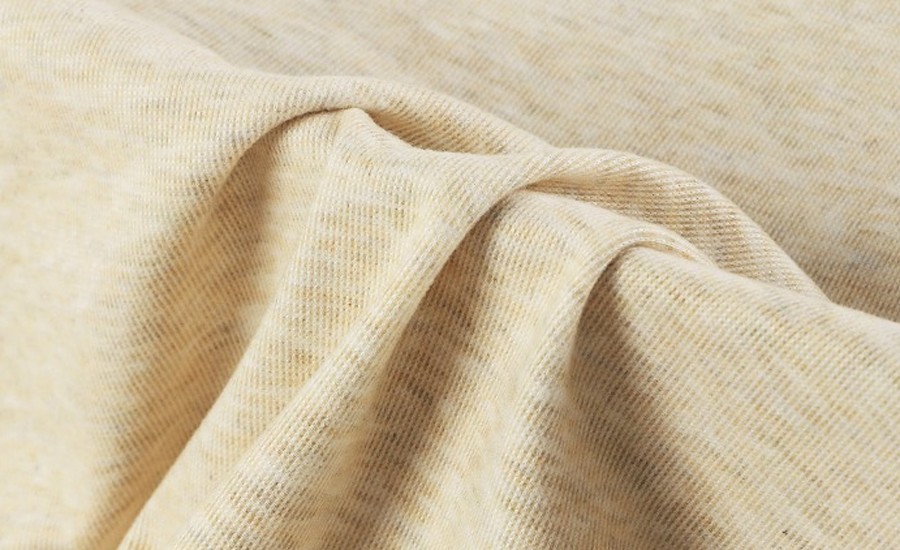
| Hand | Dry, dense and faintly fuzzy on the brushed face, smooth and cool on the back. That is the whole trick of a sheep-cashmere knit: the pile hides the filament, so the cloth never reads as polyester until you look at the care label |
| Surface | Brushed on one face only. The reverse is a clean plain knit, so an unlined hem, a rolled neckline or a faced opening shows a smooth surface inside — and the cloth is not reversible: pile in and pile out are two different garments |
| Colour | Stock card, quoted by number (No.001–No.096), or dyed to order against an approved lab dip. Approve the shade on brushed cloth, never on greige: raising the pile lifts fibre ends that scatter light, and a lot that matched before brushing can read half a shade lighter after it |
| Dyeing | Piece dyed, with the polyester and the rayon on separate dye routes so the two come out level; a mill that runs it as one polyester bath gets a patchy, heathered face that the brush then exaggerates |
| Fastness | Good on wash and rub. On a cream or oat shade the test that matters is bleeding and greying at the seam, not the shade itself — we test after washing, not only before |
| Shrinkage | The rayon relaxes on the first wash and the panel shortens in the length; the elastane holds the width. Wash-test before cutting a programme and put the allowance into the length |
| Pilling | Low to moderate. A raised filament pile has little to shed, but a brushed face always carries some fibre ends: agree a pilling grade with a rub test, and keep a bag strap, a seat belt and a cuff out of the approval photo, because those are where a pile shows wear first |
| Sublimation is a poor route: the rayon does not take disperse dye, so the print lands on the polyester and leaves the rayon chalky — obvious on a cream ground. Pigment print, screen print, burnout-style effects and embroidery all sit well on a brushed face; test an all-over print on the actual cloth, and remember a print flattens the pile where the screen touches | |
| Making up | Ball-point needle 75–80 and a walking foot at low pressure; a standard foot polishes the pile flat along the seam. Sew with the nap running the same way on both sides of the seam, or the seam reads as a shade line. Press on the reverse with steam only |
| Cutting | Rotary knife, one direction per lay. Nap has a direction: run a hand up the roll and down it and the shade changes, so every panel in a garment must be cut the same way round. A sleeve cut against the body is the classic reason a brushed knit “changes colour” in a shop window. Raw edges curl towards the brushed face — predictable, so a raw hem is fine if the curl is allowed for |
| Origin | Shaoxing City, Zhejiang, China |
| MOQ | 300 kg per shade |
| Price | US$ 15.15 / kg (300–999 kg) · US$ 13.77 / kg (1,000 kg+) |
| Yield | ≈ 2.15 running metres per kg at 252 GSM × 185 cm (≈ US$ 7.06 per running metre, ≈ US$ 3.82 per m²) |
| Lead time | Stock shades ship from the dye lot on hand; dyed-to-order shades are confirmed at quotation |
| Packing | Roll-packed, roughly 20 kg per roll, poly bag inside a woven sack |
| Sample | Hanger swatch free; a 1 m cut of a stock shade charged at cost and credited against the bulk order |
| Documents | Invoice, packing list, B/L, certificate of origin; test reports on request |
| Care | Machine wash cool (30°C), gentle cycle, do not bleach, do not tumble dry, dry flat in shade, cool iron on the reverse only, no fabric softener |
One face is brushed — cut accordingly
Brushing lays the fibre ends down in one direction, the way a cat’s fur lies. Run your hand up the roll, then down it, and the cloth changes shade. That is not a defect and it is not something a finisher can remove; it is the structure of a raised surface, and it means a brushed knit has a direction the way a corduroy or a velvet has one.
Every panel, the same way round. If the sleeve is cut against the body, the two read as different shades under raking light — in a shop window, in a photograph, and in the customer’s first complaint. It costs nothing to prevent: one direction per lay, marked on the marker. On a 185 cm roll that is easy to hold; on a narrower roll an economical marker usually turns a panel, and that is exactly how the fault happens.
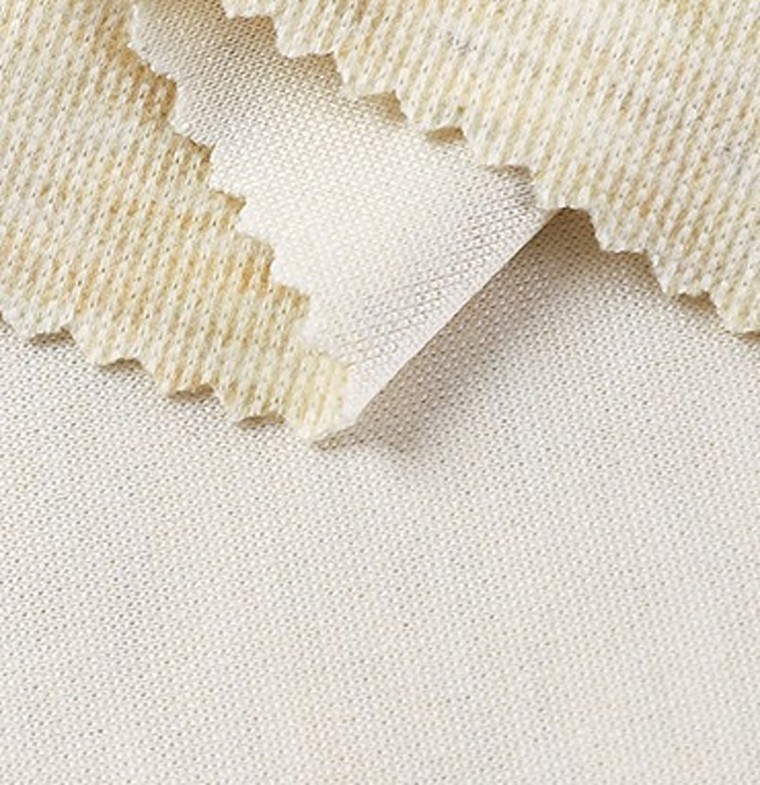
Pile in, or pile out. Pile against the skin traps a layer of air and feels warm on contact — the thermal base layer in the photograph. Pile out gives a fleece-looking outside that pills where a strap, a cuff or a seat belt rubs. Both are correct garments; they are not the same garment. Put the choice in the tech pack, because a factory that spreads the roll the other way has quietly made the second one.
252 GSM of loft, not of density
A fleece jacket is thick because it is heavy. This is thick because it is raised: the same yarn is pulled into a pile instead of being packed into a tighter loop, so the panel stands 2–3 mm proud of the body and weighs what a mid-weight jersey weighs. Compress it in your hand and it comes back; fold it and it does not crack along the fold.
The arithmetic at 185 cm. One running metre covers 1.85 m² and weighs about 466 g, so a kilo runs about 2.15 metres and a 300 kg minimum is roughly 644 metres. At 185 cm a base-layer body is a full front panel plus a sleeve across the width — if you are used to 160 cm, the marker is where this cloth gets cheaper, not the price list.
Why not simply buy fleece. Because fleece is a garment in itself, and this is a cloth that goes under one. It sits flat under a shirt, it does not add bulk at the shoulder, and it can be cut on the same block as a jersey tee. That is the whole reason thermalwear looks like underwear rather than like outerwear.
84 / 12 / 4, and the cost of brushing a stretch knit
Each number does one job. 84% polyester holds the brush and keeps the shade: a filament loop raised into pile does not mat down after ten washes the way a staple cotton fleece does. 12% rayon takes the polyester edge off the hand and pulls moisture off the skin, which is what separates a base layer from a plastic bag. 4% spandex is recovery — the cloth follows a knee and comes back, instead of bagging at the seat by February.
But brushing a spandex knit is a narrow window. The wire rollers are set against tension: too much tension, or two passes where one will do, and the wire catches the elastane filaments and cuts them. What comes off the machine looks fine on the roll end and fails in the garment — a weak spot that grows into a hole at the knee, a chalky streak down the length, a band where the pile is shorter and the shade steps. Ask for the nap to be checked across the full width at both ends of the roll, not just at the face of it.
That is also why the shade is approved on brushed cloth. Raising the pile lifts fibre ends that scatter light, so a lot that matched the standard before brushing can read half a shade lighter after it. Approve the swatch you will actually cut, and keep a retained piece per dye lot.
Where this weight earns its money — and the wash it will not survive
Thermal tops and bottoms, loungewear and pyjama sets, base layers, kids’ winter sets, the inside of a reversible-looking knit, hats and neck warmers. The common thread is a garment worn against the skin, washed often, and judged on how it feels in the first thirty seconds.
Three care rules do most of the work. Wash at 30°C on a gentle cycle — a hot wash plus agitation is what felts a pile into patches. No tumble drying: heat and tumbling mat the surface permanently, and no iron will bring it back. No fabric softener: it coats the fibre ends, the pile collapses and the cloth stops feeling like cashmere and starts feeling like a worn towel.
If the programme is an industrial or high-temperature wash — hospitality, healthcare, rental workwear — say so at quotation. A rayon-blend brushed knit with 4% elastane is not built for a 60°C bleach cycle, and it is cheaper to hear that now than after the first bulk delivery.
Four things that go wrong on a brushed knit. Mixed nap direction: panels cut up-and-down in the same garment read as two shades — one direction per lay. A hot iron on the face: flattens the pile into a permanent shine; press the reverse, with steam, through a cloth. The tumble dryer: mats the surface into felted patches that cannot be raised again. Sublimation print: the rayon stays chalky and on a cream ground it is the first thing anyone sees — pigment or screen print instead.
Ask for a hanger swatch and a price
Tell us the shade number, the weight of the programme in kilos and what you are cutting. We reply within one working day with the price on the lot we hold, the shade card, and a brushed hanger swatch so you can check the pile and the shade in daylight before you commit.
Related: if you want the same wool-like surface with a lighter, drier hand and no elastane, see the Wool-Touch TR Stretch Knit 215 GSM; if you want thickness that holds its own shape without a lining, the TR Air Layer 320 GSM is the same mill’s three-layer route. The rest of the range is on the fabrics page.