Fabrics / Cotton & rayon · Printed jersey
Rayon Spandex Floral Print 220 GSM, 160 cm
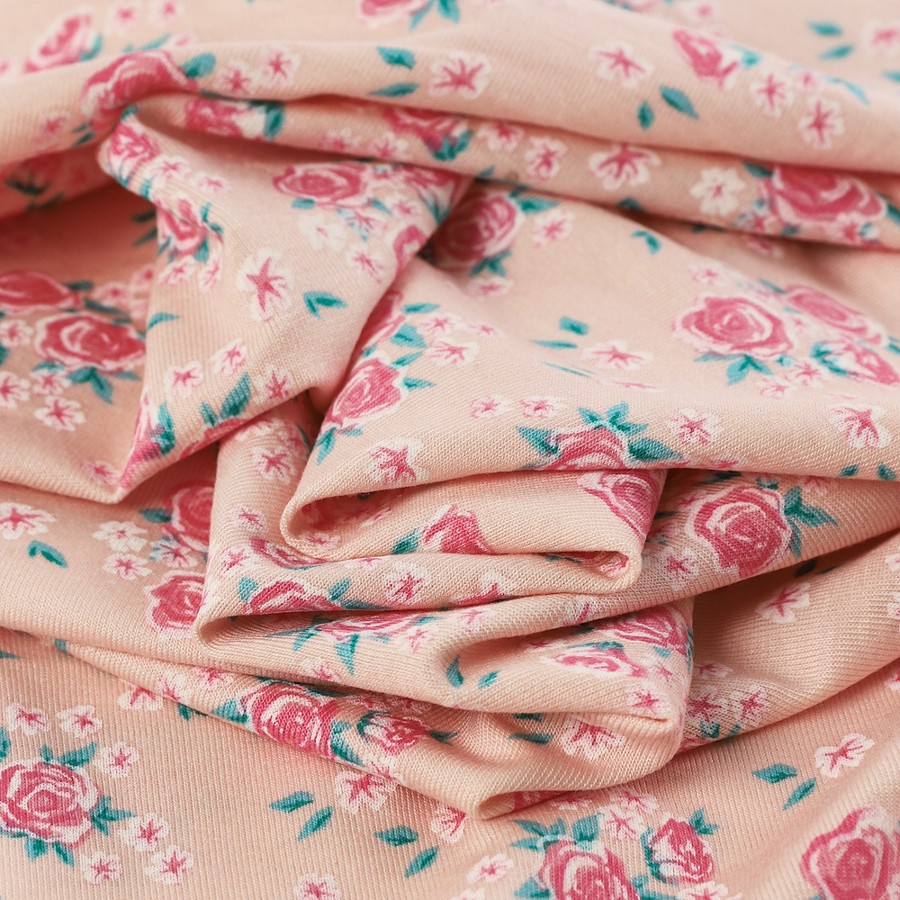
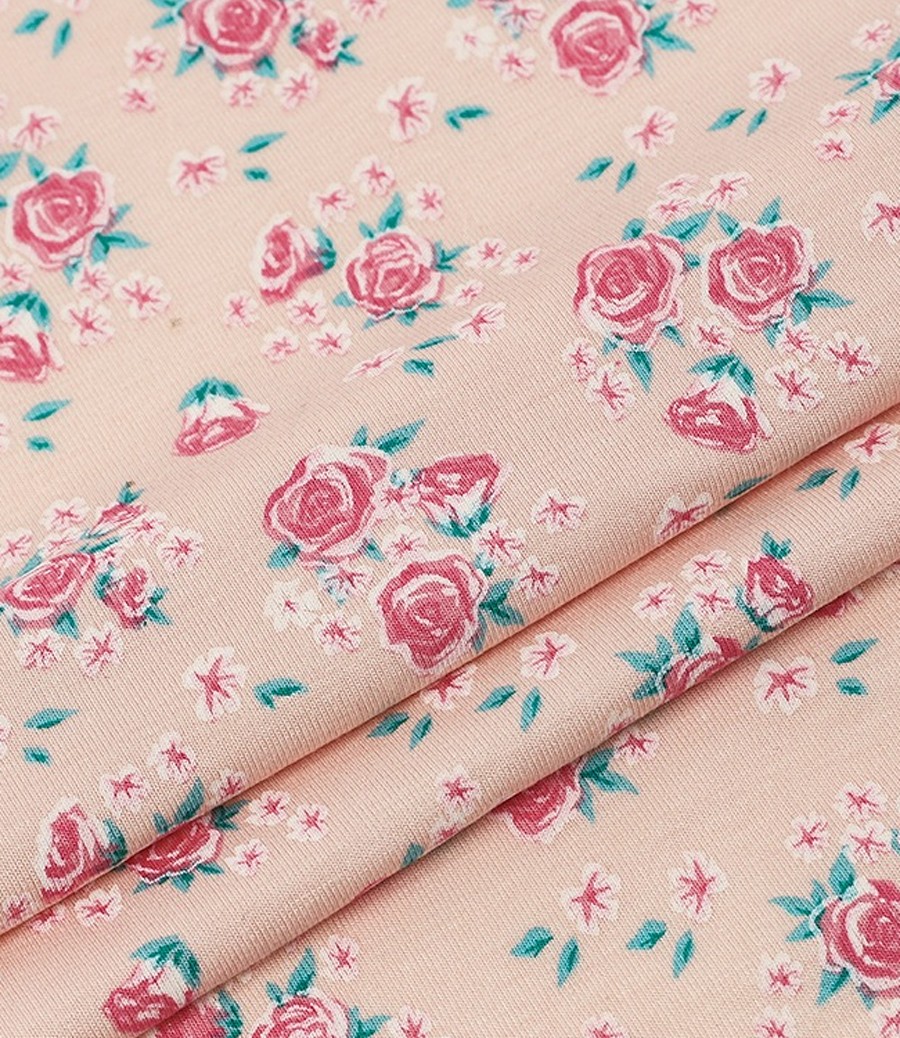
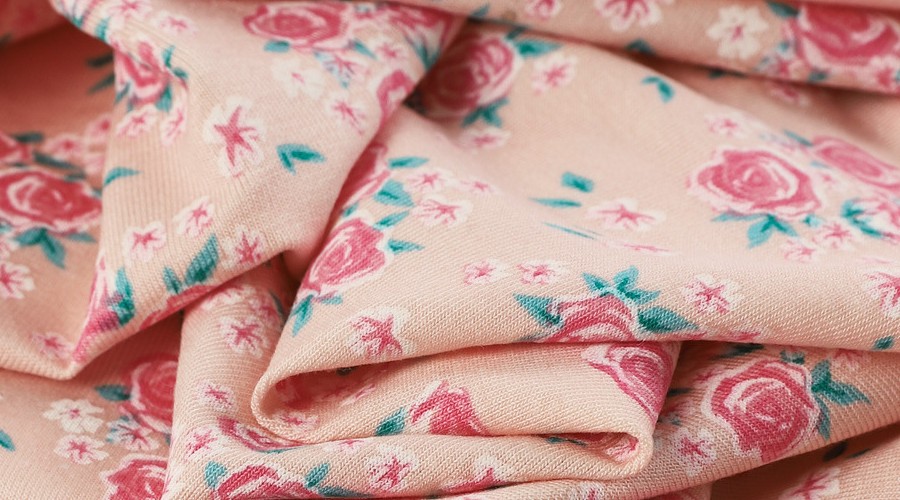
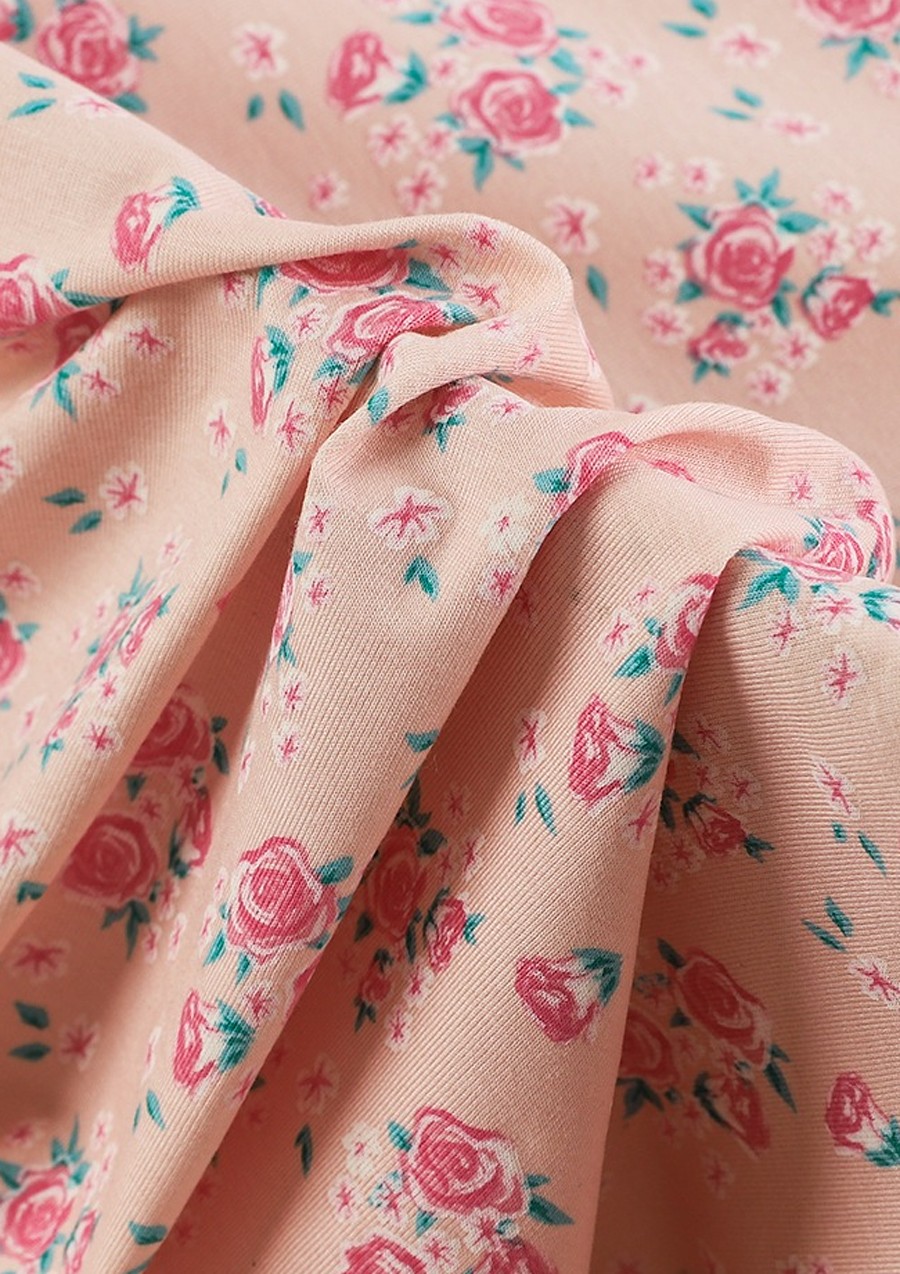
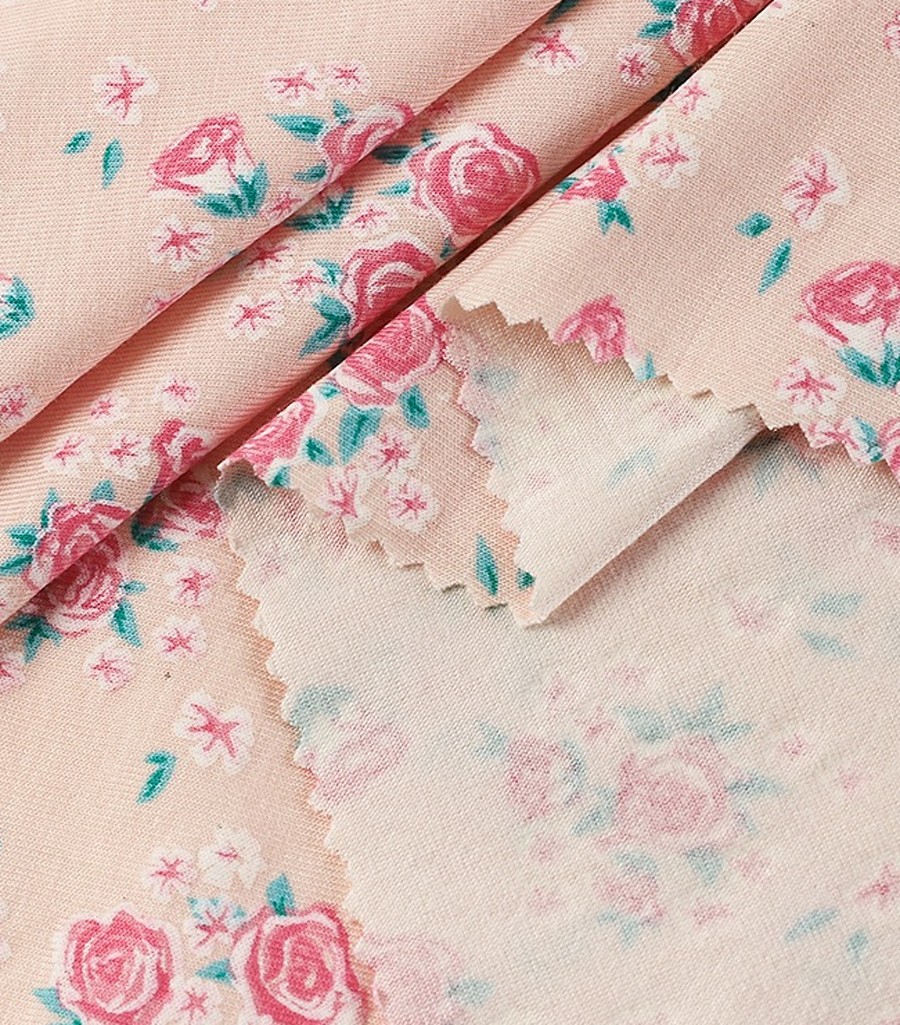
A printed single jersey in 95% viscose 5% spandex, 220 GSM on a 160 cm width. A scattered rose toss — single blooms at thumbnail scale with teal leaves and white star flowers — on a blush ground. Heavy enough for pyjamas, day dresses and childrenswear to be cut from the same roll, and soft enough that the print does not stiffen the cloth. The ground and the artwork are both open: choose a stock ground by number, or send us a design and we print it from 300 kg.
On the pattern. The flower is ours, but it does not have to be. Most of what we print is a buyer’s own artwork — a file or a swatch, scanned and strike-offed on the ground colour you want. Two things we ask before we start: that the design is yours to print, in writing, and that the colour count is one we can hold. We will not print a design that reads as another brand’s trademark, and we would rather decline at the enquiry than at the port.
- Composition
- 95% viscose / 5% spandexrayon jersey, four-way comfort
- Weight
- 220 GSM6.5 oz/yd² — heavy jersey
- Width
- 160 cm63 inch — plan the marker
- Structure
- Single jersey, printeda scattered floral on blush
- MOQ
- 300 kg≈ 852 running metres
- Colour
- No.001–No.096 or your artworkown designs from 300 kg
Full specification
| Customization | Available — shade, weight, width and artwork confirmed at quotation |
|---|---|
| Knitting technics | A single jersey, circular knit, run on 220 GSM at 160 cm. The 5% spandex is plaited in rather than blended flat, so the stretch comes back rather than growing out: the cloth recovers at the cuff and the knee. It is a knit, not a woven cloth — no warp, and no lining needed for the drape |
| Print method | Two routes, and the order size decides which. Under roughly 1,000 kg we print digital direct-to-fabric: no screens, no set-up charge, and the fine tonal gradation in the roses is reproduced as it was drawn. Above that we move the design to rotary screen, which needs a screen engraved per colour — a one-off cost, and a lower unit price that only pays back at volume. Tell us the quantity first and we will tell you which route is cheaper, not the other way round |
| Composition | 95% viscose, 5% spandex. Viscose is a regenerated cellulose fibre — it takes dye and print paste deep, it breathes, and it drapes; the spandex is what keeps a close-fitting jersey from growing. No polyester, no cotton. On a printed viscose the fibre and the print have to be matched at the finishing stage, because the two behave differently in water |
| Yarn | Viscose spun yarn in the ground, spandex filament plaited in. The viscose is what the print sits on, which is why the ground reads soft and slightly dry rather than slick. Counts are set at order |
| Yarn count | Set at order |
| Weight | 220 GSM / 6.5 oz/yd². Heavy for a jersey: it holds a pyjama short without being see-through, it takes a dress weight without a lining, and it does not cling. Lighter than this and the print starts showing the body underneath; heavier and it stops being a summer cloth. We hold the single figure rather than a band |
| Width | 160 cm / 63 inch, open width. Narrow, and worse than it looks on a printed cloth — read the marker note below before you cost a garment |
| Pattern | A scattered rose toss in a small repeat: single blooms at thumbnail scale with a sprig of leaves and white star flowers between them, on a blush ground. Non-directional — there is no up or down to the design, which is unusual and useful (see the cutting note). The repeat is confirmed on the strike-off, not on a screen: approve the strike-off on your own ground colour and sign it, because the same file on a different base reads differently |
| Colour | Stock grounds quoted by number (No.001–No.096), or your own artwork printed to order from 300 kg. The quality is shown on a blush ground with rose and teal. If you are bringing a design, send it as a repeat-ready file (TIFF or PSD at 300 dpi, layered) or as a physical swatch we can scan; we will tell you before sampling whether the ground and the number of colours are viable |
| Print coverage | The print sits on the face and does not strike fully through — look at the pinked edge in the photographs and you can see the reverse running paler. That is normal for a pigment or digital print on a knit, and it is fine for a lined garment or for a print that reads as a surface. It is not fine for an unlined scarf, a reversible jacket or a garment that will be worn inside out. Say so at enquiry and we will quote a different route rather than let it fail at the sample |
| Hand | Soft, cool and slightly dry, with the body a 220 GSM jersey has. The spandex keeps it close without gripping. After the first wash the viscose relaxes and the cloth gets softer still — the print does not stiffen it, which is the usual complaint on a cheap pigment print |
| Drape | Fluid with weight behind it. At 220 GSM it falls into a fold and stays there rather than collapsing, which is why the same quality sells into pyjamas, day dresses and childrenswear without changing anything but the pattern |
| Stretch | Roughly 40–50% cross-wise and 20–30% length-wise from the 5% spandex. Cut it as a stretch cloth: negative ease on a bodice, ribbed or banded necklines, and a stitch that stretches with the seam. A pattern drafted for a stable jersey will be loose by the end of the day |
| Shrinkage | 5–7% on the first wash in both directions unless the finisher controls it, which is normal for a viscose jersey and is why the cloth is washed and relaxed before it ships. Wash-test a panel before cutting a programme: on a printed cloth shrinkage also moves the print, so a panel that shrinks 6% will not match a panel that shrinks 3% at the seam |
| Pilling | Moderate — grade 3–4 on the random-tumble test. A viscose jersey pills more than a cotton one because the fibre is weaker and the ends work loose; the print does not protect the surface. On a pyjama or a day dress it is not a problem, on a tight-fitting legging it is. If the order is close-fitting, ask for the higher-grade finish and expect to pay for it |
| Fastness | The one figure to ask for on this cloth is wet crocking, and specifically on the rose. A deep pink on a viscose ground is the combination that crocks: rub it damp against white and it will mark. Ask for grade 4 or better on wet rub, ask for the five-wash shade hold at 30°C, and if the garment has a white collar, a white lining or a white piping, test that combination rather than the print on its own |
| Making up | A fine ball-point needle, a light tension and a seam that stretches: overlock the edges, and use a cover-stitch or a twin needle at hems so the seam gives with the cloth. Do not fuse a high-temperature interlining behind the print — heat and pressure on a printed face will flatten the pattern and leave a ghost. Use sew-in or a low-temperature fusible |
| Cutting | Here is the useful part: a scattered print does not need a one-way lay. There is no up or down to the design, so panels can be nested both ways and the marker gains 8–15% against a directional print. What it does need is registration at the seam: match the repeat at the side seam and at the centre front, and accept that on a small toss print a perfect match is impossible at every seam — agree with the buyer which seams are critical before bulk, not after |
| Pressing | Low to medium heat, 130–140°C, steam, on the reverse through a cloth. Direct heat on a printed face glazes the binder and the rose goes shiny and slightly darker — and on a graded print that shine sits exactly where the pattern is most visible |
| Abrasion | Moderate. The print binder wears before the cloth does at a high-rub point — inside the thigh, under a bag strap, at the seat. On a pyjama or a dress nobody notices; on a work legging it shows as a pale patch. If the garment is close-fitting and worn hard, print a lighter ground rather than a deep one |
| Origin | Shaoxing City, Zhejiang, China |
| MOQ | 300 kg per shade or per artwork |
| Price | US$ 13.00 / kg (300–999 kg) · US$ 11.67 / kg (1,000 kg+) |
| Yield | ≈ 2.84 running metres per kg at 220 GSM × 160 cm (≈ US$ 4.58 per running metre, ≈ US$ 2.86 per m²) |
| Lead time | Stock grounds ship from the lot on hand; a new artwork adds 10–15 days for the strike-off and your approval before bulk |
| Packing | Roll-packed, roughly 20 kg per roll, poly bag inside a woven sack |
| Sample | Hanger swatch free; a 1 m cut of a stock ground charged at cost and credited against the bulk order |
| Documents | Invoice, packing list, B/L, certificate of origin; test reports on request |
| Care | Machine wash cool (30°C) inside out, gentle cycle, mild detergent, no chlorine bleach. Wash separately for the first two washes — a new deep pink on viscose will bleed a little and it will find white in the same drum. Tumble low or dry flat in the shade; press warm on the reverse. Do not leave it soaking and do not dry it in direct sun, which fades a print faster than it fades a dyed cloth |
300 kg of your own design — and where the price turns
Most print suppliers want 1,000 kg before they will talk about a new design. This one starts at 300 kg, because the first route is digital: the design goes straight onto the cloth, no screens are engraved and there is no set-up charge to amortise. That is also why the fine gradation in these roses survives — each petal is built from graded dots, not from a flat block of colour.
The economics flip somewhere around a tonne. Above that, rotary screen printing is cheaper per metre, but every colour in the design needs its own engraved screen — a one-off cost that only pays back over volume. So the question is not “which method is better”, it is “how many metres am I running”. Tell us the quantity in the first message and we will tell you which route is cheaper for that quantity, rather than quoting the method we happen to have loaded.
Deep pink on viscose: the number to ask for is wet crocking
Colour fastness is a list, and most of it does not matter on this cloth. Light fastness is fine, wash fastness is fine, perspiration is fine. The one that fails is wet crocking — rubbing the damp print against something pale. A deep pink on a viscose ground is the classic case: the fibre holds the paste, the paste releases under moisture and pressure, and the mark lands on whatever is next to it.
Where it bites is not on the print, it is on the join: a white collar band, a white lining, white piping, the inside of a pyjama hem against a sheet. So ask for grade 4 wet rub on the rose, and if the garment has a pale component, test the two together rather than the print alone. We quote the figure with the cloth — a supplier who cannot give you a number has not tested it.
A scattered print is the one that does not need a one-way lay
On a directional print — stripes, a border, a large motif with a top and a bottom — every panel has to be cut the same way up, and the marker pays for it. This design is a toss: the roses are scattered, there is no up or down, and a panel can be nested either way. On a 160 cm width that is worth 8–15% of the marker, which on a 300 kg order is more money than the difference between two suppliers’ per-metre prices.
What it does still need is registration at the seam. A scattered repeat will not match perfectly at every join — that is arithmetic, not workmanship — so agree with the buyer which seams are critical (side seam and centre front, usually) and which are allowed to break. A mismatch accepted at approval is a design detail; the same mismatch found at goods-in is a defect. Put it in writing on the tech pack.
160 cm, and what 300 kg actually makes
At 220 GSM on 160 cm a running metre weighs about 352 g, so a kilo runs about 2.84 metres and the 300 kg minimum is roughly 852 metres. A pyjama set — top and short — takes 2.0–2.4 m at this width, so the minimum lands around 355–425 sets; a short-sleeve day dress takes 1.5–1.8 m and the minimum is roughly 470–570 dresses; a child’s dress takes under a metre, which is why this quality also sells as a kids programme alongside an adult one.
160 cm is narrow for a print, and it costs more here than on a plain cloth. A print has to be centred and matched, so you cannot slide a panel sideways to save width the way you can on a solid shade: the marker has to respect the repeat. Lay the marker on the actual repeat before you compare this quality with a 170 cm print — the per-garment difference is usually larger than the per-metre difference.
Four things that go wrong on a printed viscose jersey. Wet crocking: deep pink against white, test the pair not the print. Strike-through: the reverse runs paler — no reversible garments. Shade of the ground: approve the strike-off, not the screen, because the same file on a different base reads differently. First washes: wash separately, cold, inside out, or the pink finds the white.
Send a design, or ask for a swatch and a price
Tell us the ground colour, the quantity and the garment. If you are printing your own artwork, send the file (300 dpi, repeat-ready) or a physical swatch and we will come back with the strike-off cost, the lead time and a view on whether the colour count holds on this ground. If you are buying the stock floral, we will send the shade card and a hanger swatch.
Related: the same viscose jersey without the print is the Modal Jersey 120 GSM; for a heavier viscose in a knit, see the Acetate-Touch Double-Face 220 GSM. The rest of the range is on the fabrics page.