Fabrics / Cotton & rayon · Rib trim
Cotton-Like Cuff Rib 187 GSM, 300 cm
A 2×2 rib knit in 95% polyester 5% spandex, 187 GSM on a 300 cm open width. This is a trim, not a garment cloth: it is the cuff, the neckband, the waistband and the leg opening, bought to continue a body fabric it will never be sewn next to in the same structure. Soft and dry enough to pass for cotton in the hand, and it holds a shade through washing that a cotton rib cannot. We dye it to your body cloth, not to a chip.
On the name. “Cotton-like” describes the hand, and there is no cotton in this cloth — it is polyester and spandex. If your care label has to read cotton or a cotton blend, this is not that fabric and we will tell you so at the enquiry rather than at the sample. What the name is really pointing at is why the trim on a schoolwear, workwear or uniform programme is almost always polyester: the body cloth has to survive a hundred industrial washes, and a cotton rib at the cuff frays, fades and bags long before the garment behind it does. We make cotton ribs too — if the label says cotton, ask for one.
- Composition
- 95% polyester / 5% spandexcotton-like hand, no cotton in it
- Weight
- 187 GSM5.5 oz/yd² — light trim weight
- Width
- 300 cm118 inch — a slit tube, and the labour figure
- Structure
- 2×2 ribcut the strips across the wales
- MOQ
- 300 kg≈ 535 m ≈ 25,000 garments’ trim
- Colour
- No.001–No.096 or dyed to matchmatched to your body cloth
Full specification
| Customization | Available — shade, weight, width and rib depth confirmed at quotation. 1×1 and 2×1 ribs can be knitted on the same base if the quantity supports the run |
|---|---|
| Knitting technics | A 2×2 rib, knitted as a tube on a circular rib machine and slit open to 300 cm. Rib is a two-needle-bed structure: the wales alternate between the beds, which is what makes the cord stand up, and which is also why a rib feels twice as substantial as its gramme weight suggests. It is a knit, not a woven band — there is no warp and no selvedge, so the edge will curl unless it is cut and joined |
| Composition | 95% polyester, 5% spandex. No cotton, despite the name — read the note below. The polyester is what holds the shade and the shape through repeated washing, which is the real reason workwear and schoolwear trim is usually polyester rib rather than cotton: a cotton rib shrinks, fades and bags at the cuff long before the garment behind it gives up. The 5% spandex is what brings the rib back after it has been stretched over a head or a hand |
| Yarn | Polyester spun yarn in the ground, spandex filament laid in at the two needle beds. The spun yarn is what gives the soft, slightly dry cotton-like surface; a filament polyester rib reads slick instead. Counts are set at order |
| Yarn count | Set at order |
| Weight | 187 GSM / 5.5 oz/yd². Light for a rib — deliberately. It is built to trim a 150–190 GSM jersey or interlock, not a fleece. We hold the single figure rather than a band |
| Width | 300 cm / 118 inch, open width from a slit tube. This is the most commercially important number on the page: it decides how many bands come off one cut. See the note below before you cost a programme |
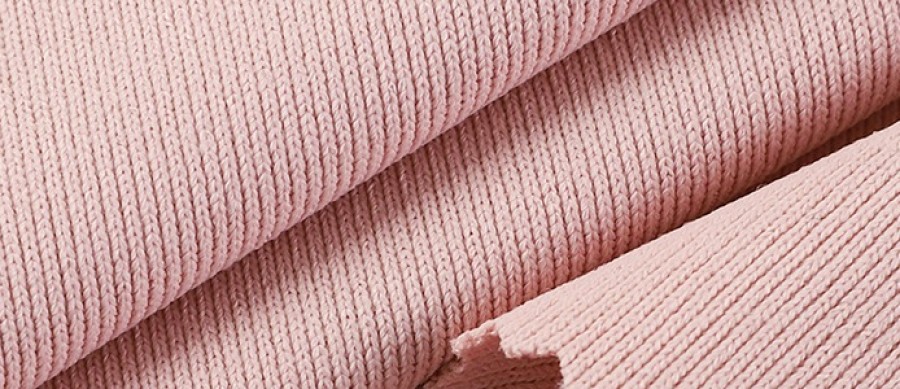
| Rib structure | 2×2 — two wales raised, two sunk, repeating across the width. A 1×1 rib is finer and flatter and is what you put on a fine jersey neckline; 2×2 is the cord you see on a sweatshirt cuff, and it holds a deeper, more elastic channel. The count of wales per centimetre is confirmed on approval, because it changes with the machine gauge and it changes the finished band width you can cut |
| Colour matching | This is the whole product. A rib is bought to continue a body cloth in a different structure, and two structures never take dye the same way: a rib packs more yarn into the same area and its corded surface scatters light differently, so the same recipe on a jersey body and a rib trim returns two different depths even from one bath. What “matching” buys is a correction made against the rib and approved as a pair. Three practical asks: send us a piece of your body cloth — we dye to the cloth, not to a chip; approve the lab dip with both pieces side by side, in daylight and under the light your customer will see it in; and if your body cloth is coming from another mill, get that mill’s approved standard, because “black” is not one number |
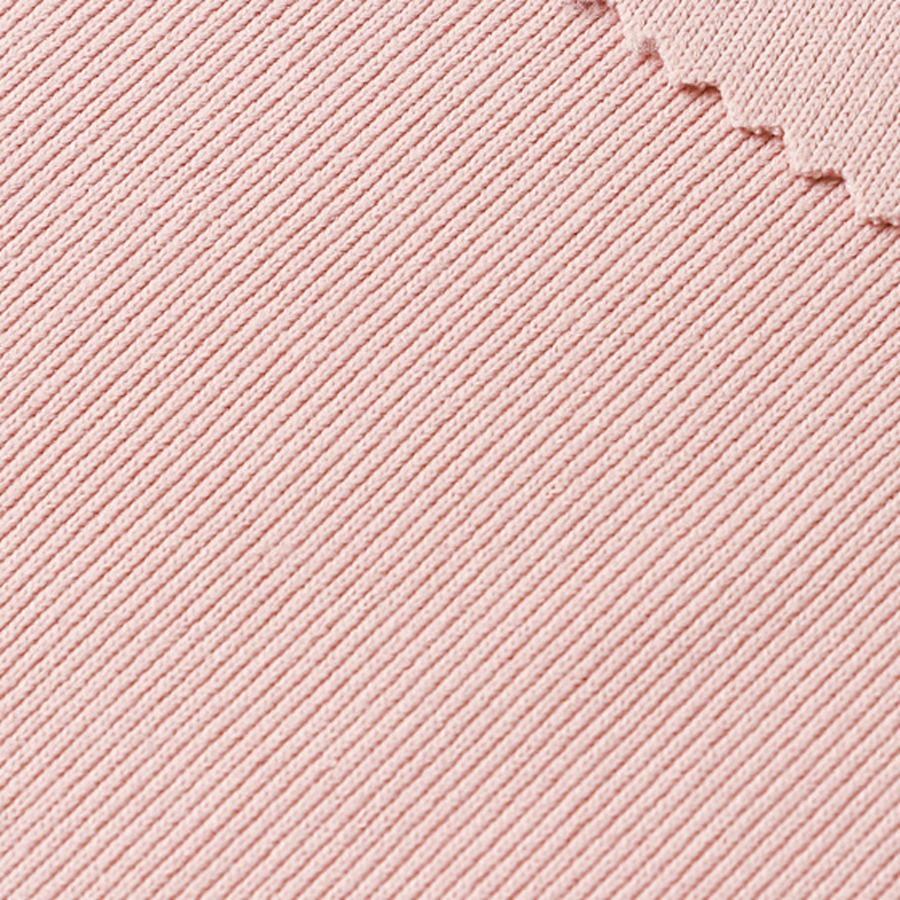
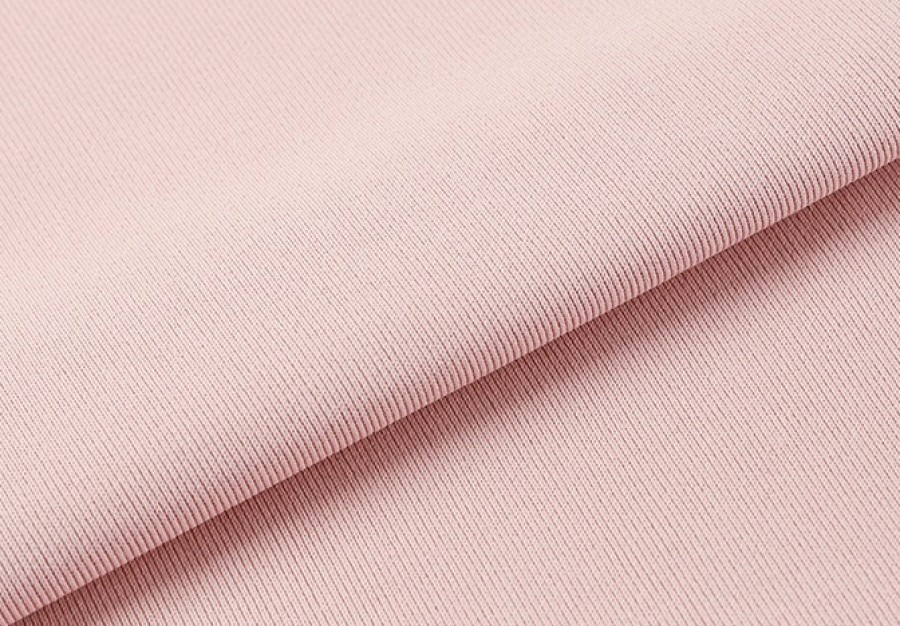
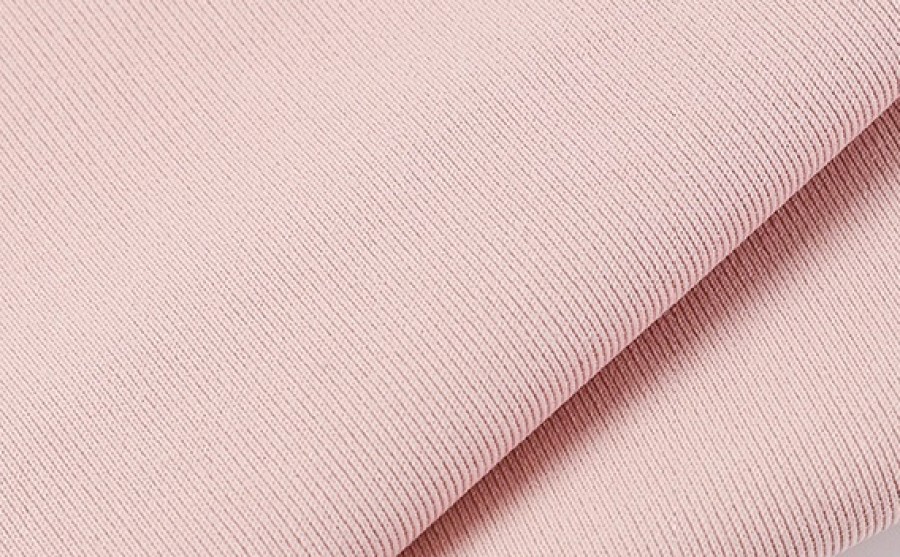
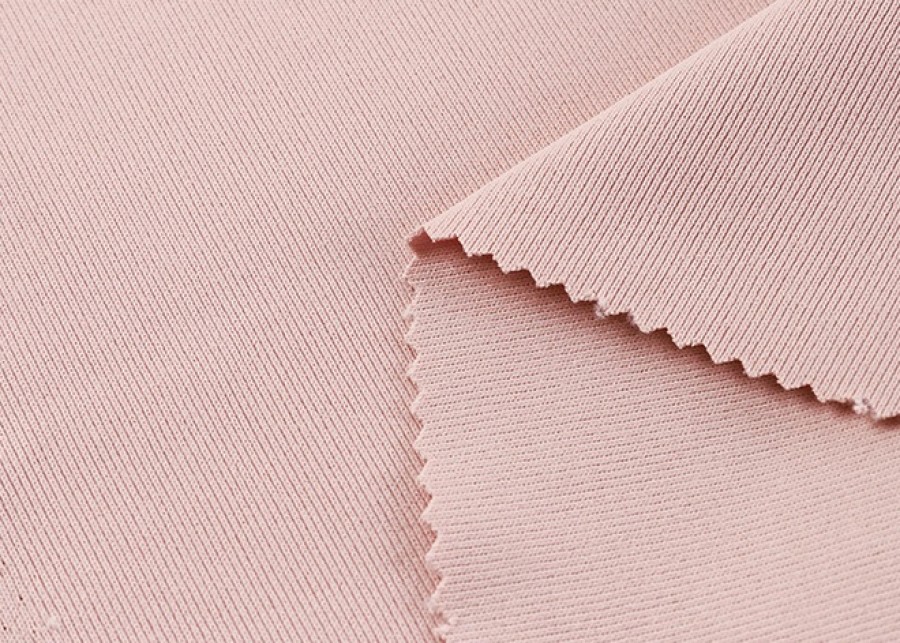
| Colour | Stock shades quoted by number (No.001–No.096), or dyed to match a body cloth you supply. The quality is shown in a dusty rose. If you are matching, send the swatch with the enquiry and tell us the garment and the wash programme — both change the recipe |
| Hand | Soft, dry and close to cotton — the “cotton-like” in the name is a genuine handle, not a marketing line. Slightly springy across the width because of the cord, and noticeably lighter in the hand than a 280 GSM sweatshirt rib. It does not have the cool, slippery feel of a filament polyester |
| Stretch & recovery | Opens roughly 90–110% across the wales. The figure that actually matters is not how far it opens, it is growth after 30 minutes: stretch it, hang it, measure it again. A good spandex rib comes back inside about 5%. A rib that opens beautifully and grows 10% will be a slack cuff after twenty washes, and no amount of better sewing will fix it. Ask for the number with the lot |
| Shrinkage | 3–5% length and 2–4% width on the first wash, controlled by heat setting. It moves less than a cotton rib would — which is part of why it is used on programmes where the body cloth and the trim are cut from different deliveries and have to still line up after a year of washing |
| Pilling | Grade 3–4 on the random tumble test, because the yarn is spun rather than filament. On a cuff or a neckband that is normally enough. On a waistband that rubs against a bag strap or a seat belt, ask for the higher-grade finish and expect to pay for it |
| Fastness | Wash and light fastness are not the risk on this cloth. The two that matter are phenolic yellowing — a wrapped roll stored beside a phenolic-treated carton or a freshly painted wall yellows, and it is invisible until the roll is opened — and sublimation, if a dark rib is pressed hard against a pale one at high temperature. And one absolute: chlorine destroys spandex. A single wash in a chlorine drum takes the recovery out of the cuff permanently. Put it on the care label |
| Heat setting | Spandex has to be heat set, and the setting temperature is the whole game: too cool and the rib grows in the roll, too hot and the spandex loses its memory before the garment is even cut. We set under tension and cool under tension — ask for the setting temperature and the growth figure with the lot, and do not let a finisher re-set it without the number |
| Making up | A ball-point needle, a light tension and a seam that stretches with the band. But on a rib the ratio matters more than the seam: a neckband is normally attached at 85–92% of the opening it has to close, and a cuff at 80–90%. Sew it in at 100% and it will stand away from the body; sew it in too tight and it will cup. Agree the ratio on the tech pack — it is the single most common reason a sample cuff looks wrong while the fabric is perfectly good |
| Cutting | Cut every strip across the wales, so that the length of the band runs in the course direction. That is the direction the rib opens, and a band cut the other way will not stretch around anything. On a slit tube this also means the band length is limited only by the 300 cm width — see the note below on what that is worth |
| Pressing | Low, 120–140°C, through a cloth, never direct and never held. Direct heat on spandex glazes the surface and quietly kills the recovery — the band looks fine on the table and goes slack on the second wash. Steam is safer than a hot shoe |
| Abrasion | Good. The cord takes the rub rather than a flat surface, so a rib wears at the top of the wale and keeps its appearance longer than a flat knit of the same weight. The failure mode is not abrasion, it is relaxation |
| Origin | Shaoxing City, Zhejiang, China |
| MOQ | 300 kg per shade. On a trim this is a mill minimum rather than a programme quantity — read the note below |
| Price | US$ 13.00 / kg (300–999 kg) · US$ 11.67 / kg (1,000 kg+) |
| Yield | ≈ 1.78 running metres per kg at 187 GSM × 300 cm (≈ US$ 7.29 per running metre, ≈ US$ 2.43 per m²) |
| Lead time | Stock shades ship from the lot on hand; dyeing to match a body cloth adds 7–10 days for the lab dip and your approval, plus bulk |
| Packing | Roll-packed, about 20 kg per roll, poly bag inside a woven sack |
| Sample | Hanger swatch and shade card free; a lab dip against your own body cloth charged at cost and credited against the bulk order |
| Documents | Invoice, packing list, B/L, certificate of origin; test reports on request |
| Care | Machine wash cool (30°C), mild detergent, no chlorine bleach — chlorine destroys the spandex and the cuff will not come back. Tumble low or line dry; press warm on the reverse through a cloth. Do not leave it soaking and do not iron the band flat, which is how a good rib is turned into a ribbon |
A matching rib is a colour job, and the rib is the piece that moves
The buyer’s problem is never “find a rib”. It is “find a rib that still looks like my body cloth by the time it is sewn to it”. Two structures never take dye the same way: a rib packs more yarn into the same square centimetre and its corded surface scatters light differently, so the same recipe on a jersey body and a rib trim returns two different depths — even out of one bath. That gap is what a matching service is for, and it is why a rib quoted against a Pantone chip rather than against your cloth will disappoint you eventually.
Three things that make it work. Send a piece of the body cloth so we dye to the cloth, not to a number. Approve the lab dip as a pair — both pieces side by side, in daylight and under the light your customer will actually see it in, because a dusty rose that matches at noon can go grey in a shop. And if your body cloth is coming from another mill, get that mill’s approved standard in writing: “black” is not one number, and a rib dyed to someone else’s memory of black is the most common mismatch we are asked to fix.
300 cm is not a width, it is a labour figure
Rib comes off the machine as a tube. 300 cm is that tube slit open, and the number is not an accident — it is what decides how much of your cost sits in the cutting room. Every trim component is a strip whose length runs across the width: a neckband is 45–60 cm, a cuff 20–25 cm, a legging waistband 65–85 cm. On 300 cm you get five neckbands, or twelve cuffs, out of a single pass of the cutter. On a 150 cm tube you would get two and six. Same cloth, same price per kilo — roughly half the cutting labour and materially less waste at the end of the roll.
And then the awkward part, which is better said here than in a quotation. 300 kg is a mill minimum, and on a trim it is a large number: a sweatshirt uses about 0.065 m² of rib for two cuffs and a neckband, so 300 kg at this width is roughly 25,000 garments’ worth of trim. Most single programmes need 40–80 kg. So either consolidate two or three shades into one order, or take a stock shade and buy it by the roll. If neither works, say so and we will tell you honestly whether this mill can serve you or whether you should be talking to a trim converter.
2×2: the structure opens, the spandex returns
Two wales up, two down, repeating. The raised cord is what opens when you pull it; the 5% spandex is what brings it back. Those are two different properties and buyers usually test only the first — pull a cuff, watch it stretch, call it elastic. The one that decides whether the garment survives twenty washes is the second.
So the figure to ask for is growth after 30 minutes: stretch it, hang it, measure it again. A good spandex rib comes back inside about 5%; one that grows 10% is already a slack cuff on the table and will only get worse. The other half is direction — cut every strip across the wales so the band’s length runs in the course direction, because that is the only direction it opens. A strip cut the other way looks identical and will not stretch around anything.
187 GSM: what it can cuff, and what it cannot
187 GSM is light for a rib. A sweatshirt cuff is normally 280–320 GSM, and if you put this on a 320 GSM fleece the cuff will read thin, sit flat, and relax before the body does — the garment then looks cheap at exactly the point a buyer looks first. It is built to trim a 150–190 GSM jersey or interlock: tees, leggings, underwear, childrenswear, polo plackets and the neckband on a light top. If your body cloth is a fleece, ask us for the heavier rib instead of trying to make this one work.
The other honest limit is skin. This is a trim, and trim is the right job for a 95% polyester rib — a cuff, a neckband, a placket edge touches skin briefly and none of polyester’s weaknesses matter there. A body panel or a full innerwear garment is different: polyester does not manage moisture, and a rib structure holds what it absorbs. On a legging waistband it is entirely standard and fine. On something worn as a whole garment against the skin, ask us for a cotton or cotton-blend rib — we knit those too, and we would rather point you at one than sell you this.
Four things that go wrong on a rib trim. Shade against the body cloth: approve the pair, not the chip. Cut direction: across the wales, or the band will not stretch. Growth: ask for the 30-minute figure, not the elongation. Heat and chlorine: a hot iron flattens the cord and kills the recovery, and one chlorine wash takes the spandex out permanently.
Send a piece of your body cloth
That is the whole enquiry. Tell us the garment, the shade you are matching and the quantity, and post or courier a swatch of the body fabric — we will come back with a lab dip dyed against it, the growth figure for the lot, and a price at your volume. If you are buying a stock shade instead, we will send the shade card and a hanger swatch and you can be cutting inside a week.
Related: the jersey this rib is normally matched to is the Poly-Spandex Single Jersey 200 GSM, and if your body cloth is heavier, the Interwoven 3-Thread Fleece 200 GSM needs a heavier rib than this one. The rest of the range is on the fabrics page.